Great! But you think that Jew, a proper noun, should be lowercase, even though lowercasing is registered in dictionaries as offensive? And would lowercase Judaism not be just grammatically improper? (It's literally a proper noun.) And would you use other racial terms judged offensive? Obviously it's common on this forum, but I bring it up since I'm talking about stumbling blocks.
Granted it's not grammatically correct, but the rest is tone policing. It's not meant to be offensive. I'm not a native speaker and my language doesn't capitalize nouns. That's how I've always written jews, arabs, indians and other ethnic groups. I'm writing informally here and I consider this pedantry.
The first "they" could have antecedent as "Rabbinical [J]udaism". The second "they" cannot, so it must be either "the Pharisees and the Sadducees" or a generic reference, but you imply it's not a generic. And it's wasn't "the Pharisees" or "the Sadducees" as a collective who did it, but some of them, seeing as many Pharisees became Christians or were sympathetic (Hillel, Gamaliel, Nicodemus, Joseph, Paul, Acts 21:20). When the Bible uses a collective like this it's clear in context that it means some, but in English a collective like "the Pharisees crucified Messiah" is easily mistaken as being a delegated group activity attributable to all members rather than an activity of individuals. So, since you affirm you don't want to say it was all Jews, I suggest continuing sensitivity to whether your words might be mistaken that way.
I said "they" refers to the pharisees and their tradition which brought about what we now call Judaism. Again you're being pedantic and I have to qualify everything I say - yes, not all pharisees went after Jesus. I'm obviously talking about those who did and formed their sect in opposition to Christ. Again, I'm not writing an academic paper here and even if my exposition is not without fault, I believe it manages to get what I mean across when understood within context.
"False Jews" is not the text. Perhaps you've fallen into a trap laid for some by intending to mean Jesus's words "which say they are Jews, and are not, but do lie". Since Jesus says they're not Jews, they're not Jews. That leads to people objecting that many Rabbinical Jews are not Jews at all. In their own self-authoritative opinion.
Yes, I meant that passage. It still means the same so whatever. You're arguing over semantics.
But Jesus always upheld the right of the Jewish nation to decide who was a Jew, and in general people-groups have the right to self-identify and to determine who is and who isn't a member (to say otherwise would be to say Americans can't enforce their border). So we don't get the right to "other" the Ashkenazi Jews, for instance, and say they're not Jews.
Is this why Israel requires proof of jewish ancestry and DNA testing to get a citizenship? Go try to self-identify and see how it goes. The whole point of being jewish is "othering" non-jews aka gentiles. This is a constant theme in the OT.
Today's Ashkenazi have both Semitic and external (probably Khazarian) lineage, and the Jewish polity at large accepts this, and we don't get to say they made an error 1,000 years ago because that would be one nation (us) warring against another.
Sure, they decide the legal notion because it's their state. But it doesn't change the fact that many of them are probably not descendent from the tribes of Jacob and are not jews/Isrealites in the sense used in the Bible.
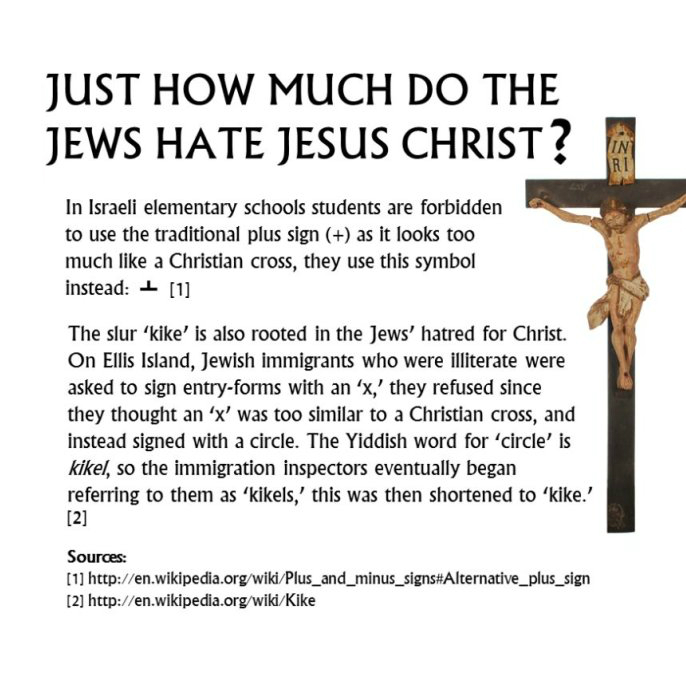
All non-Christians are generic heretics for not having come to Christ, and all non-Christians "crucified Christ" in the same sense I did; but that is not what people mean when they make Rabbinical Jews a special case. They mean that Judaism is itself as a system opposed to Jesus Christ, and the facts I've observed on the ground is that Judaism as a system tries very hard to take no position for or against Jesus Christ and to avoid taking such a position at great lengths. Even the separate allusion to Jews not wanting to mark with an "X" out of conscience is an avoidance of a position out of developed conscience and not an opposition. So, it's true the Rabbinical Jews are "heretics" in the same sense that all men are without Christ, but the fact that their Scriptures describe the true God in great detail indicates that we shouldn't preclude the idea that they might find the true God who is in Jesus by following the same Scriptures we use.
Yeah right. They never expressed anti-Christian sentiments - it was the evil Christians historically that prosecuted them for no reason at all. Or maybe the reason you don't find explicit evidence that they hate Christ and blaspheme Him is because they are wary of being caught in the act? They are careful about doing it in public but many jews who converted admit blaspheming Christ is a usual occurrence in their gatherings (they admit much more too). They're known to spit at the sound of our Lord's name. The reason they don't want to draw a cross or an X is because the sign of the cross repulses them and they know it has power. Satan and the demons squeal before the cross. Antichristian attitudes among the jews are well documented by the Church and by laypeople throughout history. The entertainment industry which is ran by jews mostly is full of antichristian sentiments and propaganda. Have you seen the Paris Olympics ceremony? Let's be real here.
So we don't get to diss the modern Jews when we remember how many OT Jews are saints in heaven watching us right now; instead we wait to point out our criticisms until we have established entree to speak where we will be heard and understood. That is done by demonstrating our ability to respect all Jewish history and treat the Jewish nation considerately: in fact, tongue in cheek, to treat them as considerately as any other goy (nation, Gen. 25:23).
You sound like an ADL lawyer dude. Come on. Don't conflate the Abrahamic hebrew tradition (which is Christianity) with the sect of Judaism. No Christian has a duty to respect judaizers who misinterpret Scripture and twist the truth. The Church Fathers didn't mince words too and would be considered "anti-semitic" by today's standards. Jews are not like the pagan nations because they know the one true God and His Son incarnated as a jew. They apostatized and rejected their own Messiah (I'm talking about the ones that did aka rabbinical Judaism) - this is what makes them distinct and why their judgment is different.
Now, I see the side issue is also interesting to you. I don't see the Torah laws "transformed" from legalism to liberty.
You're putting words in my mouth. I never said anything about liberty. The transformation that occurs is the result of the fulfillment of the OT rituals and symbols in the real body of Christ. All the symbols - circumcision, baptism, Temple worship, sacrifice, mana, Israel of God, etc were actualized in the God-Man. Worship is obedience and God requires to be worshipped as He has instructed us. Temple worship was appropriate until the Church was established.
Therefore he didn't "transform" it (but many people were so steeped in idolatry that restoration of their original did look like transformation). To the faithful Jews, of which up to a million accepted his message within the generation, he made it safe to keep the original Torah again.
If He didn't transform Mosaic law, then why don't we observe it as the jews do but worship in a different manner? It was impossible to observe the original Torah after the Temple was destroyed. The faithful became the Church and worshipped according to the NT, not the Torah.
As a Christian who teaches the Hebrew roots I know Messianics who argue it is proper for Christians to slaughter and eat a lamb for Passover at home (not at the church altar because that is not the law), and, while it would be an affront for someone not in the body of Christ to do so, I can't tell them they're sinning when they in good conscience eat lamb for Passover in exactly the same way Jesus himself did.)
I'm from Eastern Europe and slaughtering and eating lamb is an well known Pascha tradition. I don't see what the problem would be - it's a feast and we celebrate that way. It's not a sacrificial lamb of course and it has nothing to do with worship.
This leads to the objection: Something changed at the cross, so certain things "good" before are "bad" after. I don't see that being the change. The things that were bad after the cross were bad for not being from the heart, in the same way they were bad before the cross. The change was that the body of Christ was wide-open to Gentiles, and at the first Orthodox Council (Acts 15) it was recognized that Gentiles had the laws of Noah and not of Moses. Both legal systems point to the same God via the same requirement of trusting in the Anointed as God reveals him; they just apply to different nations. The Messianic Jews continued, as I showed, to keep the Torah as perfectly as it could be kept, and the Gentiles continued to honor the generic statement of the Ten Words (given to all nations) that the Council stated, which is one formulation of the Laws of Noah. So when the church's demographic became largely Gentile the operative demonstration of righteousness among them was (as always) the Laws of Noah, or effectively the Ten Words; but in our day the question of operative demonstration of righteousness, via changed heart, is being shifted back to recognizing that Jews are free to keep the Laws of Moses unto Jesus, just as Moses that great saint did.
It's not good vs bad - all of God's law is good and just. It is about what is appropriate for the time and the place. What was appropriate for Adam wasn't appropriate for Noah. What was appropriate for Noah wasn't appropriate for Moses, etc. Once God became flesh and was resurrected, the world was made anew so everything changed. Christ was the second Adam and He restored the pre-fallen human nature, defeating death and opening our path to eternal life in God. The jews of Acts 15 were part of the Church and they were allowed to continue OT worship but that was provisional and circumstantial and only applied to the very early days of the Church. Paul says there are no jews or gentiles but everyone is one in Christ. We all share the same faith, rituals and sacraments.
Like circumcision, the physical does not necessarily deny the spiritual, while if there is no circumcision of the heart then both are denied.
Never said that. I said the physical was fulfilled and transcended in Christ and the spiritual was left.
tone policing ... my language doesn't capitalize nouns
Touche! My bad. All the same you're in a forum and platform where very many use collectivist language like "the Jews did" to mean a charge against every man, woman, and child. So I'll be happy to trust that you're not intending that, and not worry about it unless some other intent manifests clearly.
What Jesus meant in the plain sense in Rev. 2:9, 3:9 was clearly historically defined by the very interesting letters of Ignatius (which I anticipate Orthodoxy reveres). Ignatius described exactly those two cities as hosting a group of Gentiles who talk about Judaism and not Jesus Christ (Philadelphians 6:1). This was about 12 years after Jesus prophesied concerning them, and we can infer from Ignatius that they did literally worship at his feet in repentance just as Jesus prophesied. (What Ignatius literally said was that they received his personal preaching and need no further criticism, indicating repentance, 6:3; and that they thought his Spirit-revealed information was humanly orchestrated in relation to their schism, indicating their being shocked by the miraculous revelation, 7:2.) I'd been praying for decades to know what happened in those two churches that Jesus was prophesying about, and then suddenly he revealed it to me and I wrote that summary.
Now those who care little for Ignatius or history have for some time used "synagogue of satan" in a very different sense that is very little related to Jesus's words or primary intent, even though he knew this twist of language would happen. I don't think he wants me to countenance letting the language slip when the history is so clear, so I point out the reality to people. There is very truly a broad work of satan to infiltrate many, and to poison the Jews in very special ways, and in the article I indicated the seed of discerning seven different works of satan warned against in Rev. 2-3, among which the infiltration in Rabbinical Judaism is a single hydra head. Analytically I warned that those Jews who are satanists are more likely best categorized as a "dwelling of satan" because they reflect Pergamum syncretization. That part may be semantic, but I find it necessary to direct people away from collectivism.
The whole point of being jewish is "othering" non-jews aka gentiles.
I don't think so; Moses repeatedly said love the stranger as yourself and have the same law for the stranger and yourself. Othering is imposing collectivism on outsiders. "Gentiles" is the ordinary word for nations, which I showed applies to the nation of Israel too. There are many cases in the Bible and Talmud where Jews or Gentiles insult other people-groups; Jesus is accused of doing it by parabolically comparing the Syro-Phoenician to a dog, and by calling Pharisees vipers. I believe direct accusation like that is only justified by reference to immediate evidence at hand and not to an unstated narrative (racism); and it should never include the innocent (e.g. children) with the guilty. So we shouldn't tell Jews they're not Jews, and Jews shouldn't tell whites that Jews count as white and not as white as convenient.
many of them are probably not descendent from the tribes of Jacob
I've asked for evidence of that and it doesn't come from either Khazaria or Edom (which were intermarriage mergers) so I don't think there is any.
Yeah right. They never expressed anti-Christian sentiments
I didn't say that; I said that anti-Christian sentiments were never made a point of Jewish theology, even though they circulated among the people. The closest we have is the "blessing" against the "minim", which doesn't mean Christian but any separatist, sectarian, or apostate. Though some would have used it conscientiously against Christians, that would be an individual judgment of the speaker separating himself from Christianity, and we don't have historical showing that that's what was intended. What we do have is a debate of "minim" with Rabbi Simlai, in which the minim are not proto-trinitarians at all but are indistinguishable from gnostic tritheists! Well of course we agree with cursing tritheists!
they are wary of being caught in the act
Absolutely! And on this point we should not judge formally without catching them in the act; that's the same credit the Church gave heretics. But I don't know an anathema against Jews, only (mostly Roman) restrictions.
many jews who converted admit blaspheming Christ is a usual occurrence in their gatherings
I respect that testimony. Individuals will be judged, but judging the system is about judging what it does directly by delegation, not by what people do in it individually.
They're known to spit at the sound of our Lord's name.
Yes, some believe in the nonverbal demonstration of purity from alleged idolatry. The individual who judges a Christian will be judged; but the rabbis distance themselves from the individual's judgment. I suppose if we caught the rabbi defending the judgment of Christianity as idolatry, that might meet my standard, but they generally don't.
Maybe I'm wrong to give them this much credit based on the fact that their Scriptures and traditions should point them to Jesus the Messiah and the goal of sharing good news by allowing them the environment to discover it for real. But as long as they toe a minimum standard, one which has kept Jewish-Christian relations from spilling over against them, I don't believe in more belligerence.
Don't conflate the Abrahamic hebrew tradition (which is Christianity) with the sect of Judaism.
All the faithful Israelites believed in Messiah's coming and can indeed be called Christian. And Rabbinical Judaism can indeed be called a sectarian, but the two sides split in the fog of war (primarily in 68 when Messianic Jews fled Jerusalem and Temple Jews stayed, as Jesus prophesied) so I wouldn't put schism on either at that point. But (as Catholics and Orthodox claim the same church history) Jews and Christians claim the same covenant history. It seems to me enough Catholics are doing right to keep the name alive (you might disagree), and it's unlikely enough Rabbinical Jews are openly doing right to keep their name alive (but about a million Messianic Jews are doing right), but the dilemma is very similar. So even as I grant them access to the same tomb of Abraham as myself, I'm aware not to conflate.
No Christian has a duty to respect judaizers who misinterpret Scripture and twist the truth.
Correct, Judaizers meaning legalists of any kind, but not Judaism when it should mean the true original faith of the Jews. When Rabbinical Judaism misrepresents and twists, we can politely criticize, and be heard if we have their willingness to listen.
They apostatized and rejected their own Messiah (I'm talking about the ones that did aka rabbinical Judaism)
But see, after hundreds of the rabble repented to Peter and became charter Orthodox Christians, the perpetuation of the Pharisaic system into Rabbinical Judaism never took a side against Jesus. In fact, Hillel the Pharisee ruled as Sanhedrin president (nasi) on behalf of all Jews that Judaism's official position is Wait And See. (And Maimonides respected that for all his talk about Jesus.) The Pharisees who became Christians merged into the polity of the Christianity of all nations; the Pharisees who didn't tried to preserve Hillel's stance and maintain a temple-less system under great provocation, and God by his grace let them have a flickering flame to do so. For the praise of his glory in revealing the truth in this generation, BTW. So I should probably frame it that way: the official Jewish position has never departed from Wait And See, even as individual later rabbis (I only know of one for sure, Ulla c. 300) did personally reject Jesus directly.
I never said anything about liberty.
Granted, that was Paul. So you mean a transformation (fulfillment) from symbol to actualization in Jesus. Now, I ask people to consider Jesus's other clause, nonabolition ....
Temple worship was appropriate until the Church was established.
I find no evidence that it was inappropriate afterward either, or that non-temple traditions were inappropriate, if people accepted them willingly, from the heart, and with gratitude for what God had revealed and trust in what was yet to be revealed. If Jesus was revealed to a person who knowingly rejected the revelation, that's not trust in God; but many Jews today stand in the same position as remote unreached peoples in that their culture has insulated them against getting any meaningful revelation about the good news of Jesus, and so they have not provably consciously rejected him. Paul says someday they will get it, the light will come on en masse, and the day of resurrection will be at hand; and I can participate in that process.
why don't we observe it as the jews do
Because the Law is received voluntarily: all Noah's family received his laws for their people (everyone), and all Moses's family received his laws for their people (the Jews). As the Recabites show, as well as Romans 14, anyone who volunteers to take on a higher law is welcome to do so on the same terms of having (receiving) a regenerated heart seeking God. Jesus came to volunteer to keep the highest law and then to take the penalty for those who broke the simplest law. I asked God about this for decades and finally realized that the Torah was never a "have to" situation for anyone; all keeping of any law, simple or complex, is because we "get to" (that's Christian liberty, unto law).
worshipped according to the NT, not the Torah
Torah practices remained an open question in the church for about 300 years; Quartodecimans and Ebionites and others tried to work out the harmony, though some went overboard. The bishop of Rome tried once to impose a Gentile Easter, but blessed Irenaeus stopped him and counseled diversity in nonessentials. In the fourth century the bishop of Rome tried again and succeeded in quelling most all Jewish-related rituals, suspending the discussion of proper harmony by fiat, which is one reason the other four pentarchs started making the case against him as you're familiar. So "not the Torah" was not a testimony of the primitive church, only the Constantinian Roman faction, which was tolerated by the East until a time it could be settled.
I'm from Eastern Europe and slaughtering and eating lamb is an well known Pascha tradition.
God bless, and more power to you! Now, surprise, I reveal to you something unknown but that doesn't conflict with your tradition. By continuing Jesus's symbol of eating an innocent lamb and symbolizing our innocence in union with him, you are in fact doing just what Moses described as sacrifice. I'm unfamiliar with whether your region also uses bitter herbs as Moses said; I presume you use unleavened bread for the Divine Liturgy; and the exact dating has long been a quibble; but you're offering an animal to God and communally partaking of the symbol of innocence, which was his point. And, Levitically, it's the one cookout that is permitted to be done in the absence of a temple. So it would be an affront to do it in a church, but in a home it's something that can be given to God and prayed over and received. When Abel and Jesus and Paul had animal sacrifices offered, it was not an affront, because it was by faith; God always says the affront is when it's not by faith, but to seek personal merit and self-righteousness.
the world was made anew so everything changed.
That's a theory of law; when I looked into it I found several NT passages indicating a different theory, that the change was not about what we gratefully respond to God with, but it was in the fact that the perfect life of righteousness had been completed. What had been prophesied for our righteousness was now made certain by the revelation of the event. And when it happened nobody changed their practice of law immediately; they kept doing the same things they had done before. (The most salient thing they kept doing that took on new meaning was the havdalah meeting that Jews had kept for centuries before Christ, on what we call Saturday night, closing the Sabbath. Acts makes clear that this meeting, particularly at Troas, is what was transformed into the Sunday morning service over a few decades. That is no real change at all to a tradition inspired by the Mosaic Sabbath, it is only a movement from nonregulation to regulation.)
There were other changes, like the harrowing of hell that improved the status of those righteous in sheol, and the suddenness of the new church's growth. The pre-fallen human nature, made certain by Christ's death and resurrection, appears to be something that was always available to the righteous in the OT too: it's the regenerated spirit. There is a change of language associated with that; often but not always the OT has the Spirit "with" or "on" and the NT has the Spirit "in" the believer. But it appears the new heart is the same in Moses (Deut. 30) as it is in the NT.
The jews of Acts 15 were part of the Church and they were allowed to continue OT worship but that was provisional and circumstantial and only applied to the very early days of the Church.
Paul agreed with that ruling; it was the first Orthodox Council; and for 300 years it was used by all of the Hebrew-roots groups of Christians. And its removal via Rome was sus. So I'm not confident that Scripture or tradition reveals that it was provisional, circumstantial, and temporary. The text literally says they can learn Moses any Sabbath, even though many (I did too) read it as implying they can't learn anything more from Moses any Sabbath.
We all share the same faith, rituals and sacraments.
Except that the Church cuts deals with various subgroups to give them different cultural traditions (the 17 autocephalous Orthodox churches); or when it differentiates Byzantine from Western Rite. When I realized that both the Orthodox and the Catholics did that, and made distinctions among themselves, I felt a lot better about both the Protestants and the Hebrew-roots Christians.
the physical was fulfilled and transcended in Christ and the spiritual was left.
And I say the physical is also left to us despite the transcendence also appearing alongside it. We are to make the best physical we know, and I believe that learning what Jesus himself practiced is the best practice for being ready to serve his pleasure both now and at this return. The idea floating around that there is no physical left, or that the physical is discontinuous with the past physical, is a theory added to Scripture, and to tradition. Thank you again for your deep consideration.
Look, I appreciate your comment but we can argue about those points all day long and I really don't have the time to do that so I'll cut to the chase.
Here's the core of my argument: Jews within Judaism (excluding the secular jews) believe Christians are much worse than pagans/gentiles idolaters. They believe we worship the one true God as them, but that we have perverted the word of God and have spread our blasphemous heresy all over the world. Just put yourself in their shoes. If they truly love God above anything else, there's literally no bigger sin than being a Christian. No matter how hard you try to ease the dialectical tension between Judaism and Christianity and to appeal to communality in history, faith and rituals - if anything, this semblance enrages them even more because it's so much worse to pervert the truth and mix it with lies than to outright deny it and to prop up some obvious falsehood. You can't massage the glaring contradiction of Christ being God vs Christ being a false messiah away with words. This issue decides who is worships God and who's the worst heretic and blasphemer to ever exist.
This is the Judaism perspective. Keeping this in mind, it's absurd to claim Judaism and it's theological teaching isn't hostile towards Christianity. There's no point in arguing about minutia when the big picture tells you all you need to know.
Great summary and thanks for letting the thoughts simmer as I am continuing to think through yours. That does crystallize the question such that I would only make the distinction that many individual Jews regard Jesus as a false messiah but Judaism as a system does not have an official position on his messiahship. (The official position is that the Sanhedrin did offer him all rights during his trial, and that nobody has completed all the works of Messiah yet, but it says nothing about his power to complete them.)
So I give indivdual Jews credit unless they enunciate their disregard for Jesus: I do not charge them with being in a system where disregard for Jesus is tolerated and not yet officially acted on, in exactly the same way I do not charge any church members with being in a system where sexual sin is tolerated and not sufficiently officially acted on. (Pick which group of Christians you think has the highest per capita sex offender rate among clergy, I don't know which, and compare that situation.) Because I don't entertain individual accusations against elders (even in Jewish or secular organizations), I extend them trust that they're working on it, with what help they may accept from us, as long as no official statement is made.
My challenge to everyone stands: Find a congregational rabbi or rabbinical org that teaches that Judaism requires rejection of Jesus as Messiah. I tried, and others have tried, but it hasn't come up. Tovia Singer was brought up, he's an antimissionary (there are a couple other notable ones) who takes the title "rabbi" but he does not have a congregation or a right to determine collective Jewish halakhah AFAIK. The fact that antimissionaries believe Judaism should take the position you describe indicates that it doesn't actually take that position formally. So at the same time as I understand your attributing the position to Judaism, I patiently decline to judge that case when no evidence has been presented by anyone despite search.
Judaism as a system does not have an official position on his messiahship. (The official position is that the Sanhedrin did offer him all rights during his trial, and that nobody has completed all the works of Messiah yet, but it says nothing about his power to complete them.)
That's a contradiction. If they claim nobody has completed the works of the Messiah yet, this means that Jesus was not the Messiah - Him having the power or not is irrelevant to the question and an obvious red herring. I had my suspicion and gave you the benefit of the doubt but reading such pure sophistry makes me think you are not acting in good faith and run an agenda here (something other users have claimed).
My challenge to everyone stands: Find a congregational rabbi or rabbinical org that teaches that Judaism requires rejection of Jesus as Messiah.
Now now, you're getting smart with me. I said Jesus being God, not just Moshiach. Find me a rabbi who would agree with that and not call worshiping Jesus Christ as God idolatry, blasphemy and polytheism. Come on dude, you're insulting me at this point. I'm too knowledgeable on Church history, theology and philosophy for your word games to work. You're wasting taxpayer money on me.


Granted it's not grammatically correct, but the rest is tone policing. It's not meant to be offensive. I'm not a native speaker and my language doesn't capitalize nouns. That's how I've always written jews, arabs, indians and other ethnic groups. I'm writing informally here and I consider this pedantry.
I said "they" refers to the pharisees and their tradition which brought about what we now call Judaism. Again you're being pedantic and I have to qualify everything I say - yes, not all pharisees went after Jesus. I'm obviously talking about those who did and formed their sect in opposition to Christ. Again, I'm not writing an academic paper here and even if my exposition is not without fault, I believe it manages to get what I mean across when understood within context.
Yes, I meant that passage. It still means the same so whatever. You're arguing over semantics.
Is this why Israel requires proof of jewish ancestry and DNA testing to get a citizenship? Go try to self-identify and see how it goes. The whole point of being jewish is "othering" non-jews aka gentiles. This is a constant theme in the OT.
Sure, they decide the legal notion because it's their state. But it doesn't change the fact that many of them are probably not descendent from the tribes of Jacob and are not jews/Isrealites in the sense used in the Bible.
Yeah right. They never expressed anti-Christian sentiments - it was the evil Christians historically that prosecuted them for no reason at all. Or maybe the reason you don't find explicit evidence that they hate Christ and blaspheme Him is because they are wary of being caught in the act? They are careful about doing it in public but many jews who converted admit blaspheming Christ is a usual occurrence in their gatherings (they admit much more too). They're known to spit at the sound of our Lord's name. The reason they don't want to draw a cross or an X is because the sign of the cross repulses them and they know it has power. Satan and the demons squeal before the cross. Antichristian attitudes among the jews are well documented by the Church and by laypeople throughout history. The entertainment industry which is ran by jews mostly is full of antichristian sentiments and propaganda. Have you seen the Paris Olympics ceremony? Let's be real here.
You sound like an ADL lawyer dude. Come on. Don't conflate the Abrahamic hebrew tradition (which is Christianity) with the sect of Judaism. No Christian has a duty to respect judaizers who misinterpret Scripture and twist the truth. The Church Fathers didn't mince words too and would be considered "anti-semitic" by today's standards. Jews are not like the pagan nations because they know the one true God and His Son incarnated as a jew. They apostatized and rejected their own Messiah (I'm talking about the ones that did aka rabbinical Judaism) - this is what makes them distinct and why their judgment is different.
You're putting words in my mouth. I never said anything about liberty. The transformation that occurs is the result of the fulfillment of the OT rituals and symbols in the real body of Christ. All the symbols - circumcision, baptism, Temple worship, sacrifice, mana, Israel of God, etc were actualized in the God-Man. Worship is obedience and God requires to be worshipped as He has instructed us. Temple worship was appropriate until the Church was established.
If He didn't transform Mosaic law, then why don't we observe it as the jews do but worship in a different manner? It was impossible to observe the original Torah after the Temple was destroyed. The faithful became the Church and worshipped according to the NT, not the Torah.
I'm from Eastern Europe and slaughtering and eating lamb is an well known Pascha tradition. I don't see what the problem would be - it's a feast and we celebrate that way. It's not a sacrificial lamb of course and it has nothing to do with worship.
It's not good vs bad - all of God's law is good and just. It is about what is appropriate for the time and the place. What was appropriate for Adam wasn't appropriate for Noah. What was appropriate for Noah wasn't appropriate for Moses, etc. Once God became flesh and was resurrected, the world was made anew so everything changed. Christ was the second Adam and He restored the pre-fallen human nature, defeating death and opening our path to eternal life in God. The jews of Acts 15 were part of the Church and they were allowed to continue OT worship but that was provisional and circumstantial and only applied to the very early days of the Church. Paul says there are no jews or gentiles but everyone is one in Christ. We all share the same faith, rituals and sacraments.
Never said that. I said the physical was fulfilled and transcended in Christ and the spiritual was left.
Touche! My bad. All the same you're in a forum and platform where very many use collectivist language like "the Jews did" to mean a charge against every man, woman, and child. So I'll be happy to trust that you're not intending that, and not worry about it unless some other intent manifests clearly.
What Jesus meant in the plain sense in Rev. 2:9, 3:9 was clearly historically defined by the very interesting letters of Ignatius (which I anticipate Orthodoxy reveres). Ignatius described exactly those two cities as hosting a group of Gentiles who talk about Judaism and not Jesus Christ (Philadelphians 6:1). This was about 12 years after Jesus prophesied concerning them, and we can infer from Ignatius that they did literally worship at his feet in repentance just as Jesus prophesied. (What Ignatius literally said was that they received his personal preaching and need no further criticism, indicating repentance, 6:3; and that they thought his Spirit-revealed information was humanly orchestrated in relation to their schism, indicating their being shocked by the miraculous revelation, 7:2.) I'd been praying for decades to know what happened in those two churches that Jesus was prophesying about, and then suddenly he revealed it to me and I wrote that summary.
Now those who care little for Ignatius or history have for some time used "synagogue of satan" in a very different sense that is very little related to Jesus's words or primary intent, even though he knew this twist of language would happen. I don't think he wants me to countenance letting the language slip when the history is so clear, so I point out the reality to people. There is very truly a broad work of satan to infiltrate many, and to poison the Jews in very special ways, and in the article I indicated the seed of discerning seven different works of satan warned against in Rev. 2-3, among which the infiltration in Rabbinical Judaism is a single hydra head. Analytically I warned that those Jews who are satanists are more likely best categorized as a "dwelling of satan" because they reflect Pergamum syncretization. That part may be semantic, but I find it necessary to direct people away from collectivism.
I don't think so; Moses repeatedly said love the stranger as yourself and have the same law for the stranger and yourself. Othering is imposing collectivism on outsiders. "Gentiles" is the ordinary word for nations, which I showed applies to the nation of Israel too. There are many cases in the Bible and Talmud where Jews or Gentiles insult other people-groups; Jesus is accused of doing it by parabolically comparing the Syro-Phoenician to a dog, and by calling Pharisees vipers. I believe direct accusation like that is only justified by reference to immediate evidence at hand and not to an unstated narrative (racism); and it should never include the innocent (e.g. children) with the guilty. So we shouldn't tell Jews they're not Jews, and Jews shouldn't tell whites that Jews count as white and not as white as convenient.
I've asked for evidence of that and it doesn't come from either Khazaria or Edom (which were intermarriage mergers) so I don't think there is any.
I didn't say that; I said that anti-Christian sentiments were never made a point of Jewish theology, even though they circulated among the people. The closest we have is the "blessing" against the "minim", which doesn't mean Christian but any separatist, sectarian, or apostate. Though some would have used it conscientiously against Christians, that would be an individual judgment of the speaker separating himself from Christianity, and we don't have historical showing that that's what was intended. What we do have is a debate of "minim" with Rabbi Simlai, in which the minim are not proto-trinitarians at all but are indistinguishable from gnostic tritheists! Well of course we agree with cursing tritheists!
Absolutely! And on this point we should not judge formally without catching them in the act; that's the same credit the Church gave heretics. But I don't know an anathema against Jews, only (mostly Roman) restrictions.
I respect that testimony. Individuals will be judged, but judging the system is about judging what it does directly by delegation, not by what people do in it individually.
Yes, some believe in the nonverbal demonstration of purity from alleged idolatry. The individual who judges a Christian will be judged; but the rabbis distance themselves from the individual's judgment. I suppose if we caught the rabbi defending the judgment of Christianity as idolatry, that might meet my standard, but they generally don't.
Maybe I'm wrong to give them this much credit based on the fact that their Scriptures and traditions should point them to Jesus the Messiah and the goal of sharing good news by allowing them the environment to discover it for real. But as long as they toe a minimum standard, one which has kept Jewish-Christian relations from spilling over against them, I don't believe in more belligerence.
All the faithful Israelites believed in Messiah's coming and can indeed be called Christian. And Rabbinical Judaism can indeed be called a sectarian, but the two sides split in the fog of war (primarily in 68 when Messianic Jews fled Jerusalem and Temple Jews stayed, as Jesus prophesied) so I wouldn't put schism on either at that point. But (as Catholics and Orthodox claim the same church history) Jews and Christians claim the same covenant history. It seems to me enough Catholics are doing right to keep the name alive (you might disagree), and it's unlikely enough Rabbinical Jews are openly doing right to keep their name alive (but about a million Messianic Jews are doing right), but the dilemma is very similar. So even as I grant them access to the same tomb of Abraham as myself, I'm aware not to conflate.
Correct, Judaizers meaning legalists of any kind, but not Judaism when it should mean the true original faith of the Jews. When Rabbinical Judaism misrepresents and twists, we can politely criticize, and be heard if we have their willingness to listen.
But see, after hundreds of the rabble repented to Peter and became charter Orthodox Christians, the perpetuation of the Pharisaic system into Rabbinical Judaism never took a side against Jesus. In fact, Hillel the Pharisee ruled as Sanhedrin president (nasi) on behalf of all Jews that Judaism's official position is Wait And See. (And Maimonides respected that for all his talk about Jesus.) The Pharisees who became Christians merged into the polity of the Christianity of all nations; the Pharisees who didn't tried to preserve Hillel's stance and maintain a temple-less system under great provocation, and God by his grace let them have a flickering flame to do so. For the praise of his glory in revealing the truth in this generation, BTW. So I should probably frame it that way: the official Jewish position has never departed from Wait And See, even as individual later rabbis (I only know of one for sure, Ulla c. 300) did personally reject Jesus directly.
Granted, that was Paul. So you mean a transformation (fulfillment) from symbol to actualization in Jesus. Now, I ask people to consider Jesus's other clause, nonabolition ....
I find no evidence that it was inappropriate afterward either, or that non-temple traditions were inappropriate, if people accepted them willingly, from the heart, and with gratitude for what God had revealed and trust in what was yet to be revealed. If Jesus was revealed to a person who knowingly rejected the revelation, that's not trust in God; but many Jews today stand in the same position as remote unreached peoples in that their culture has insulated them against getting any meaningful revelation about the good news of Jesus, and so they have not provably consciously rejected him. Paul says someday they will get it, the light will come on en masse, and the day of resurrection will be at hand; and I can participate in that process.
Because the Law is received voluntarily: all Noah's family received his laws for their people (everyone), and all Moses's family received his laws for their people (the Jews). As the Recabites show, as well as Romans 14, anyone who volunteers to take on a higher law is welcome to do so on the same terms of having (receiving) a regenerated heart seeking God. Jesus came to volunteer to keep the highest law and then to take the penalty for those who broke the simplest law. I asked God about this for decades and finally realized that the Torah was never a "have to" situation for anyone; all keeping of any law, simple or complex, is because we "get to" (that's Christian liberty, unto law).
Torah practices remained an open question in the church for about 300 years; Quartodecimans and Ebionites and others tried to work out the harmony, though some went overboard. The bishop of Rome tried once to impose a Gentile Easter, but blessed Irenaeus stopped him and counseled diversity in nonessentials. In the fourth century the bishop of Rome tried again and succeeded in quelling most all Jewish-related rituals, suspending the discussion of proper harmony by fiat, which is one reason the other four pentarchs started making the case against him as you're familiar. So "not the Torah" was not a testimony of the primitive church, only the Constantinian Roman faction, which was tolerated by the East until a time it could be settled.
God bless, and more power to you! Now, surprise, I reveal to you something unknown but that doesn't conflict with your tradition. By continuing Jesus's symbol of eating an innocent lamb and symbolizing our innocence in union with him, you are in fact doing just what Moses described as sacrifice. I'm unfamiliar with whether your region also uses bitter herbs as Moses said; I presume you use unleavened bread for the Divine Liturgy; and the exact dating has long been a quibble; but you're offering an animal to God and communally partaking of the symbol of innocence, which was his point. And, Levitically, it's the one cookout that is permitted to be done in the absence of a temple. So it would be an affront to do it in a church, but in a home it's something that can be given to God and prayed over and received. When Abel and Jesus and Paul had animal sacrifices offered, it was not an affront, because it was by faith; God always says the affront is when it's not by faith, but to seek personal merit and self-righteousness.
That's a theory of law; when I looked into it I found several NT passages indicating a different theory, that the change was not about what we gratefully respond to God with, but it was in the fact that the perfect life of righteousness had been completed. What had been prophesied for our righteousness was now made certain by the revelation of the event. And when it happened nobody changed their practice of law immediately; they kept doing the same things they had done before. (The most salient thing they kept doing that took on new meaning was the havdalah meeting that Jews had kept for centuries before Christ, on what we call Saturday night, closing the Sabbath. Acts makes clear that this meeting, particularly at Troas, is what was transformed into the Sunday morning service over a few decades. That is no real change at all to a tradition inspired by the Mosaic Sabbath, it is only a movement from nonregulation to regulation.)
There were other changes, like the harrowing of hell that improved the status of those righteous in sheol, and the suddenness of the new church's growth. The pre-fallen human nature, made certain by Christ's death and resurrection, appears to be something that was always available to the righteous in the OT too: it's the regenerated spirit. There is a change of language associated with that; often but not always the OT has the Spirit "with" or "on" and the NT has the Spirit "in" the believer. But it appears the new heart is the same in Moses (Deut. 30) as it is in the NT.
Paul agreed with that ruling; it was the first Orthodox Council; and for 300 years it was used by all of the Hebrew-roots groups of Christians. And its removal via Rome was sus. So I'm not confident that Scripture or tradition reveals that it was provisional, circumstantial, and temporary. The text literally says they can learn Moses any Sabbath, even though many (I did too) read it as implying they can't learn anything more from Moses any Sabbath.
Except that the Church cuts deals with various subgroups to give them different cultural traditions (the 17 autocephalous Orthodox churches); or when it differentiates Byzantine from Western Rite. When I realized that both the Orthodox and the Catholics did that, and made distinctions among themselves, I felt a lot better about both the Protestants and the Hebrew-roots Christians.
And I say the physical is also left to us despite the transcendence also appearing alongside it. We are to make the best physical we know, and I believe that learning what Jesus himself practiced is the best practice for being ready to serve his pleasure both now and at this return. The idea floating around that there is no physical left, or that the physical is discontinuous with the past physical, is a theory added to Scripture, and to tradition. Thank you again for your deep consideration.
Look, I appreciate your comment but we can argue about those points all day long and I really don't have the time to do that so I'll cut to the chase.
Here's the core of my argument: Jews within Judaism (excluding the secular jews) believe Christians are much worse than pagans/gentiles idolaters. They believe we worship the one true God as them, but that we have perverted the word of God and have spread our blasphemous heresy all over the world. Just put yourself in their shoes. If they truly love God above anything else, there's literally no bigger sin than being a Christian. No matter how hard you try to ease the dialectical tension between Judaism and Christianity and to appeal to communality in history, faith and rituals - if anything, this semblance enrages them even more because it's so much worse to pervert the truth and mix it with lies than to outright deny it and to prop up some obvious falsehood. You can't massage the glaring contradiction of Christ being God vs Christ being a false messiah away with words. This issue decides who is worships God and who's the worst heretic and blasphemer to ever exist.
This is the Judaism perspective. Keeping this in mind, it's absurd to claim Judaism and it's theological teaching isn't hostile towards Christianity. There's no point in arguing about minutia when the big picture tells you all you need to know.
Great summary and thanks for letting the thoughts simmer as I am continuing to think through yours. That does crystallize the question such that I would only make the distinction that many individual Jews regard Jesus as a false messiah but Judaism as a system does not have an official position on his messiahship. (The official position is that the Sanhedrin did offer him all rights during his trial, and that nobody has completed all the works of Messiah yet, but it says nothing about his power to complete them.)
So I give indivdual Jews credit unless they enunciate their disregard for Jesus: I do not charge them with being in a system where disregard for Jesus is tolerated and not yet officially acted on, in exactly the same way I do not charge any church members with being in a system where sexual sin is tolerated and not sufficiently officially acted on. (Pick which group of Christians you think has the highest per capita sex offender rate among clergy, I don't know which, and compare that situation.) Because I don't entertain individual accusations against elders (even in Jewish or secular organizations), I extend them trust that they're working on it, with what help they may accept from us, as long as no official statement is made.
My challenge to everyone stands: Find a congregational rabbi or rabbinical org that teaches that Judaism requires rejection of Jesus as Messiah. I tried, and others have tried, but it hasn't come up. Tovia Singer was brought up, he's an antimissionary (there are a couple other notable ones) who takes the title "rabbi" but he does not have a congregation or a right to determine collective Jewish halakhah AFAIK. The fact that antimissionaries believe Judaism should take the position you describe indicates that it doesn't actually take that position formally. So at the same time as I understand your attributing the position to Judaism, I patiently decline to judge that case when no evidence has been presented by anyone despite search.
That's a contradiction. If they claim nobody has completed the works of the Messiah yet, this means that Jesus was not the Messiah - Him having the power or not is irrelevant to the question and an obvious red herring. I had my suspicion and gave you the benefit of the doubt but reading such pure sophistry makes me think you are not acting in good faith and run an agenda here (something other users have claimed).
Now now, you're getting smart with me. I said Jesus being God, not just Moshiach. Find me a rabbi who would agree with that and not call worshiping Jesus Christ as God idolatry, blasphemy and polytheism. Come on dude, you're insulting me at this point. I'm too knowledgeable on Church history, theology and philosophy for your word games to work. You're wasting taxpayer money on me.