Lathe-like machinery is an ancient thing. And with any lathe, even ugly, slaves-driven and prehistoric one, you inevitably get "magic" of ideal concentricity and roundness if you work on stock without taking it out.
It's like sawing something with rope saw - you always get perfectly flat cut surface.
If you'd bother to watch the video, he (Ben with UnchartedX) explains that it would be impossible to create these things on lathes, even modern ones. He's made several videos on this subject so far, because of how astonishing it is.
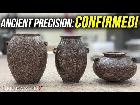
You can't lathe granite, as it is incredibly hard and has occlusions in it which will break under a lathe. Softer rocks, maybe, but not granite, or the other harder rocks that were used to make these pieces. Furthermore, all of these vases have handles, and even the curves between and part of the handles are insanely accurate (within a few microns of accuracy). There's also been further analysis of the 3D scans of some of these vases (this project only started a few months ago, by the way, and these are only the first few vases they've scanned), showing that all of the measurements and curvatures are mathematically related, often in relation to mathematical and geometric constants, even among the smallest curves in the handles, where the radii are less than 1mm. They're so accurate they can't be made by hand, and the only way we can make them today is with the best computer driven machines with multi axis capabilities, utilizing computer driven software. Even then, most modern machines introduce more error into their work than is seen in these vases, just from a simple tool change, which would be required to replicate these vases.
Truly, these vases could only be produced in a computer, with design software, and manufactured with highly precise sophisticated machines, which we have trouble replicating today...and there's tens of thousands of these vases. I've worked with rock before, for years, by hand, with hammers, chisels, saws, polishers, and other machinery. If anyone thinks these vases can be made by hand, they're deluded.
Well, long-term grinding with abrasives can and does machine and polish. Although normally one uses a sharp pointed tool on a lathe to cut, it is very common to apply a grinding wheel to a lathe piece too. Nothing prevents grinding stone instead of cutting it.
True, but like I said, that would require several tool changes, which would incur error into the final results, usually compounding the error (anyone that's polished too much material away in the beginning stages knows this, especially when dealing with extremely tight tolerances/precision). You can't polish stone (or any material) with just one grit. Getting them as smooth as these vases are requires one tool to remove material in bulk, then numerous grits of progressing fineness to polish it, all of which is a tool change. And, again, this is even ignoring the fact that the people that created these had access to modern computers, computer design software, and sophisticated multi axis machinery, which competes with what we have today. The accuracy with which these things were created can't be done by hand.

Lathe-like machinery is an ancient thing. And with any lathe, even ugly, slaves-driven and prehistoric one, you inevitably get "magic" of ideal concentricity and roundness if you work on stock without taking it out.
It's like sawing something with rope saw - you always get perfectly flat cut surface.
Geometry rulz.
Nice vases, meanwhile.
If you'd bother to watch the video, he (Ben with UnchartedX) explains that it would be impossible to create these things on lathes, even modern ones. He's made several videos on this subject so far, because of how astonishing it is.
You can't lathe granite, as it is incredibly hard and has occlusions in it which will break under a lathe. Softer rocks, maybe, but not granite, or the other harder rocks that were used to make these pieces. Furthermore, all of these vases have handles, and even the curves between and part of the handles are insanely accurate (within a few microns of accuracy). There's also been further analysis of the 3D scans of some of these vases (this project only started a few months ago, by the way, and these are only the first few vases they've scanned), showing that all of the measurements and curvatures are mathematically related, often in relation to mathematical and geometric constants, even among the smallest curves in the handles, where the radii are less than 1mm. They're so accurate they can't be made by hand, and the only way we can make them today is with the best computer driven machines with multi axis capabilities, utilizing computer driven software. Even then, most modern machines introduce more error into their work than is seen in these vases, just from a simple tool change, which would be required to replicate these vases.
Truly, these vases could only be produced in a computer, with design software, and manufactured with highly precise sophisticated machines, which we have trouble replicating today...and there's tens of thousands of these vases. I've worked with rock before, for years, by hand, with hammers, chisels, saws, polishers, and other machinery. If anyone thinks these vases can be made by hand, they're deluded.
Well, long-term grinding with abrasives can and does machine and polish. Although normally one uses a sharp pointed tool on a lathe to cut, it is very common to apply a grinding wheel to a lathe piece too. Nothing prevents grinding stone instead of cutting it.
True, but like I said, that would require several tool changes, which would incur error into the final results, usually compounding the error (anyone that's polished too much material away in the beginning stages knows this, especially when dealing with extremely tight tolerances/precision). You can't polish stone (or any material) with just one grit. Getting them as smooth as these vases are requires one tool to remove material in bulk, then numerous grits of progressing fineness to polish it, all of which is a tool change. And, again, this is even ignoring the fact that the people that created these had access to modern computers, computer design software, and sophisticated multi axis machinery, which competes with what we have today. The accuracy with which these things were created can't be done by hand.
Say, that ancient Egyptian Tesla is pretty slick.