You're not addressing the main point. Which is that NASA supposedly sent MANNED vehicles into an environment without testing them first for the ability to handle that environment. This is UNHEARD OF in industry and engineering.
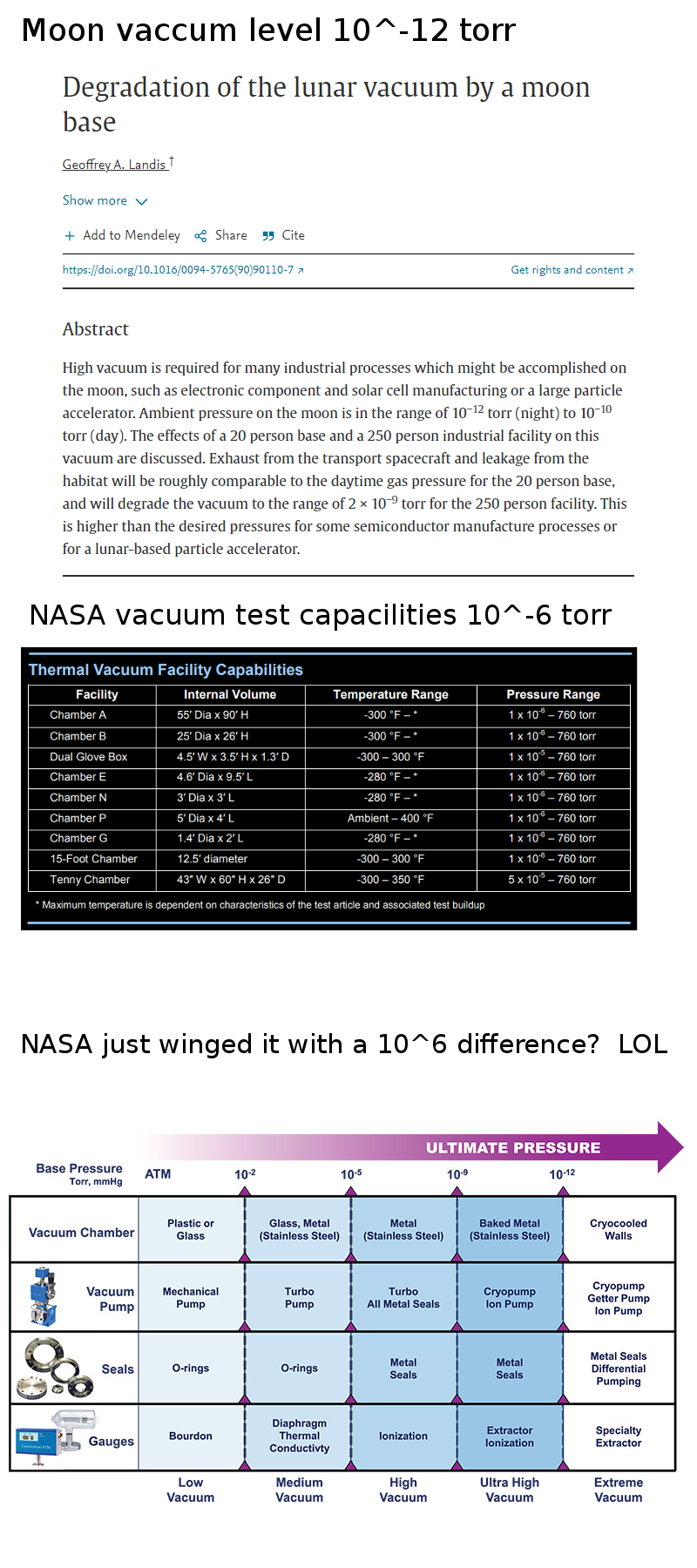
If it's so easy to build craft that handle 10^-12 torr vacuum, why not prove it in a vaccum chamber on earth?
What side is vacuum only matters structurally. The seals on hatches, space gloves, windows, any joint between materials, they all need to handle 10^-12 torr vacuum. That's hard because traditional seals like o-rings outgas at that pressure. You need metal on metal, single time use, seals. Without those, your precious 1 atm is leaking out into space FAST.
This is approaching things the wrong way. The reason is, the difference between the pressure level of an ultra high vacuum and a more moderate 10-6 torr is very little in terms of pressure. So it is completely sufficient to test for operation at 10^-6 torr rather than 10^-12 if you are looking for general effects of pressure on operation. The only thing that comes to mind that could be a problem is the bonding of metal surfaces to metal surfaces - vacuum welding - and that can be easily tested at 10-6 torr. But as far as leakages go, the absolute worst case would be how much air would leak from a ship at 14 pounds per square inch internal pressure, and there is really no need to test that to 10^-12 torr. The pressure comes from inside, and it is limited to 14 psi whereas the suck pressure can never exceed that level, in other words you would never see a sucking pressure of, say, 1000 psi and hence not need to have a test chamber that can pull that amount.
Added: I confess to an error. There would be tanks of liquid fuels and those might have higher pressures. But again, it is the pressure in the tank and not the vacuum that sets the pressure force level. So you would design the tank walls to handle P=Plf- Pvac where Pvac = 0 worst case.
Most vacuum tubes incorporated materials to combat offgassing. Meaning, the condition was well known. I assume space designers took this into account in selecting materials and designing sealant boundaries.
To test some vessel for vacuum you don't need vacuum at all.
Vessel have to sustain pressure difference between inside and outside. When vessel in vacuum, you have pressure difference of 1 bar. 1 bar absolute inside, 0 bar absolute outside.
To properly test vessel for that pressure difference you just pressurise it to 2 bar absolute inside. With 1 bar of normal atmospheric absolute pressure outside you have exactly same pressure difference as if vessel with 1 bar in vacuum.
To be shure that vessel is OK and will not leak, pressurise it to 3 bar of internal pressure. If it is perfectly sustain 2 bar pressure difference, then it will certainly sustain 1 bar pressure difference. You could even fill it with easy detectable gas to locate the leaks if any. Much more practical than using vacuum chamber for the same.
Vacuum chamber is necessary to test other things - behaviour of lubricants in outside moving parts, coatings, and other things that have nothing to do with vessel strength. And you don't need to put whole vessel into chamber for that tests.
Vacuum is not "destroying everything horrible sucking out hell". It is just 1 bar pressure difference, nothing more, very tiny difference. You have 2 bar pressure difference in your tires, 5-6 bar in your LPG tank, 3-4 bar in plumbing and 15 bar in your coffee machine. We interfere with larger pressure differences every day and barely noticing it.
Comparison of 10^-6 torr with 10^-12 torr when your vessel internal pressure is 1 bar or 750 torr is senseless. Both are negligeable and close to zero. In the terms of forces applied to vessel with atmospheric pressure inside in vacuum this "huge" difference of 10^6 between 10^-6 and 10^-12 is just 0.0000013%. Yea, I know, math and engineering is racist white supremacy horror.
Im not sure what your pointing out here. Ive reread this a few times and I dont understand how pressure degradation in the main habitat affects a production facility attached to it.
The vacuum of space is not very strong. You can build habitats out of balloons basically.
Your main concern is keeping your pressures inside, instead of the pressure outside crushing you.
Sounds like these components need to be fabricated in a location where they can create these huge vacuums, and my guess is they are talking about materials they need to either bring with them, or build on the moon to do it.
Im not sure how a moon base connects to all that, other than building a facility strong enough to do it. A regular moon base wouldnt cut it thats for sure.
Im obviously missing something ^^.
I think I get it now.
As they increase the vacumn inside the facility, the pressure of vacumn outside will become that much stronger.



You're not addressing the main point. Which is that NASA supposedly sent MANNED vehicles into an environment without testing them first for the ability to handle that environment. This is UNHEARD OF in industry and engineering.
If it's so easy to build craft that handle 10^-12 torr vacuum, why not prove it in a vaccum chamber on earth?
What side is vacuum only matters structurally. The seals on hatches, space gloves, windows, any joint between materials, they all need to handle 10^-12 torr vacuum. That's hard because traditional seals like o-rings outgas at that pressure. You need metal on metal, single time use, seals. Without those, your precious 1 atm is leaking out into space FAST.
You don't understand the concept of out gassing.
https://www.nasa.gov/feature/55-years-ago-the-first-test-flight-of-the-apollo-lunar-module
Are you just ignorant or are you lying on purpose?
This is approaching things the wrong way. The reason is, the difference between the pressure level of an ultra high vacuum and a more moderate 10-6 torr is very little in terms of pressure. So it is completely sufficient to test for operation at 10^-6 torr rather than 10^-12 if you are looking for general effects of pressure on operation. The only thing that comes to mind that could be a problem is the bonding of metal surfaces to metal surfaces - vacuum welding - and that can be easily tested at 10-6 torr. But as far as leakages go, the absolute worst case would be how much air would leak from a ship at 14 pounds per square inch internal pressure, and there is really no need to test that to 10^-12 torr. The pressure comes from inside, and it is limited to 14 psi whereas the suck pressure can never exceed that level, in other words you would never see a sucking pressure of, say, 1000 psi and hence not need to have a test chamber that can pull that amount.
Added: I confess to an error. There would be tanks of liquid fuels and those might have higher pressures. But again, it is the pressure in the tank and not the vacuum that sets the pressure force level. So you would design the tank walls to handle P=Plf- Pvac where Pvac = 0 worst case.
Materials start to off-gas at extremely low pressures. This is actually how many high-tech coatings are applied.
You can't have the material that is sealing against the vacuum off-gassing. Eventually there will be no seal.
Most vacuum tubes incorporated materials to combat offgassing. Meaning, the condition was well known. I assume space designers took this into account in selecting materials and designing sealant boundaries.
That's what all the test flights were for.
Do you think they just built the stuff on earth and then sent people to the moon without ever doing a test flight before?
So did they send animals to the moon?
Why don't you answer the question?
To test some vessel for vacuum you don't need vacuum at all.
Vessel have to sustain pressure difference between inside and outside. When vessel in vacuum, you have pressure difference of 1 bar. 1 bar absolute inside, 0 bar absolute outside.
To properly test vessel for that pressure difference you just pressurise it to 2 bar absolute inside. With 1 bar of normal atmospheric absolute pressure outside you have exactly same pressure difference as if vessel with 1 bar in vacuum.
To be shure that vessel is OK and will not leak, pressurise it to 3 bar of internal pressure. If it is perfectly sustain 2 bar pressure difference, then it will certainly sustain 1 bar pressure difference. You could even fill it with easy detectable gas to locate the leaks if any. Much more practical than using vacuum chamber for the same.
Vacuum chamber is necessary to test other things - behaviour of lubricants in outside moving parts, coatings, and other things that have nothing to do with vessel strength. And you don't need to put whole vessel into chamber for that tests.
Vacuum is not "destroying everything horrible sucking out hell". It is just 1 bar pressure difference, nothing more, very tiny difference. You have 2 bar pressure difference in your tires, 5-6 bar in your LPG tank, 3-4 bar in plumbing and 15 bar in your coffee machine. We interfere with larger pressure differences every day and barely noticing it.
Comparison of 10^-6 torr with 10^-12 torr when your vessel internal pressure is 1 bar or 750 torr is senseless. Both are negligeable and close to zero. In the terms of forces applied to vessel with atmospheric pressure inside in vacuum this "huge" difference of 10^6 between 10^-6 and 10^-12 is just 0.0000013%. Yea, I know, math and engineering is racist white supremacy horror.
Im not sure what your pointing out here. Ive reread this a few times and I dont understand how pressure degradation in the main habitat affects a production facility attached to it.
The vacuum of space is not very strong. You can build habitats out of balloons basically.
https://www.space.com/32992-beam-inflatable-space-habitat-success.html
Your main concern is keeping your pressures inside, instead of the pressure outside crushing you.
Sounds like these components need to be fabricated in a location where they can create these huge vacuums, and my guess is they are talking about materials they need to either bring with them, or build on the moon to do it.
Im not sure how a moon base connects to all that, other than building a facility strong enough to do it. A regular moon base wouldnt cut it thats for sure.
Im obviously missing something ^^.
I think I get it now.
As they increase the vacumn inside the facility, the pressure of vacumn outside will become that much stronger.
That's low earth orbit. Not space or the surface of the moon. Man has never been to either.
The pressure difference between the surface and 20m underwater is higher than the surface and outer space.
Humans have built machines that can go down 11k, you think they cannot build machines that can withstand 1ATM pressure difference?