Judaism is premised on Christ not being the messiah, you know that right? Rabbinical judaism is the tradition of the Pharisees and the Sadducees developed after the destruction of the Temple in 70 AD and codified in the Oral Torah (the Mishnah and later the Babylonian Talmud). Do you know why they pray at the Western Wall? For the rebuilding of the Temple and the coming of the Messiah who will rule over Israel and the world.
There are two small problem with this plan if you're a Christian:
First, as we mentioned the Messiah already came and they rejected Him and crucified Him. I think every Christian not completely brainwashed by zionist dispensationalist propaganda is aware of that.
Second, the Kingdom of Israel, the Heavenly Jerusalem, is in fact the Church of Christ and not a political entity or an ethnostate. You see that dual covenant theory contradicts the teaching of the Church. Why? Because God's covenant with the jews was fulfilled with the coming of the Messiah.
The whole point of the OT and "the chosen people" was to bring about the Messiah. After that we the Church became the chosen people of God. This is why Christ is called not only the second Adam, but the second Jacob, because His 12 apostles gave rise to the new spiritual "tribes" around the world - not based on biological or ethnic inheritance, but as spiritual adopted children of God. This is why in Romans Paul says our circumcision is of the heart by the Spirit and not of the flesh. And still Protestants circumcise their children according to the jewish law disregarding Romans, as if God hasn't adopted us as His spiritual children. Paul made another allegory in Romans about this - jews are the olive branch that has been cut off and the Church of believers is the wild branch that was grafted and inherits eternal life in the Kingdom, previously promised to the jews.
Does God have a plan for the jews? Some Church Fathers speak of jews converting before the second advent. But there's no "separate dispensation" for the jews - they will either repent and come to the Church or they will be condemned to hell (the same choice stands before any jew or gentile at all times).
Judaism is premised on Christ not being the messiah
Yet.
To evangelize Rabbinical Jews (which is as sensitive as evangelizing Muslims), it's important to thank the historical people for preserving the covenant for thousands of years, among which Jesus and all the Church founders were born. The fact that one group said Jesus has done enough to be judged Messiah now, and the other (eventually) said Jesus hasn't done enough to be judged Messiah now, leads to the bridge-building method of dialoguing with Jews about how we would recognize Messiah before he finishes his work. I don't see a Christian eschatology in which we fail to pray for the coming of the Messiah who will rule over Israel and the world, and if he wants a physical temple as Ezekiel 40-48 hints then I'm sure he'll get one. So the issue is the let the Jews, who seek to keep their theology pure of outside influence, find Jesus in that historical theological testimony, because he's there everywhere. Without stumbling blocks, and also without compromise.
Actually, in Acts 3-4 the very Jews who called for Jesus's death became hundreds out of the first 5,000 members of your Orthodox Church. I've posted the exegetical proof but I trust you see it on plain reading (I don't think Tradition would interpret it differently than plainly).
Yes, dual covenant is contradictory and I've never taught it; Jews are only saved by accepting Jesus, just as the Old Testament Jews were saved by believing in a Messiah to come before his name had been revealed. There are no two covenants of salvation. However, many nations have various national covenants for good or ill in the Bible, and the Jewish people have some of the best and the worst of the covenantal promises, and their preservation is pretty good evidence that they have a national promise from God to remain a people forever just like Egypt has the same national promise from God to remain forever. In fact, Egypt is told by Zechariah that if they reject the Messiah they will get drought, which is similar to what Israel is told. National covenants are not related to salvation by faith proven by works.
So the "chosen people" (not a Biblical phrase), the people of God, were a mixed multitude for two millennia, then mostly Jewish for two, then mostly Gentile for two, which Paul tells us in Romans 9-11 is a brilliant and balanced plan for the world. He concludes with how much greater it will be to see Jews evangelized en masse again (like they were in his day, when Acts 2021:20 says many myriads in Jerusalem alone were Messianic Jews): he says in fact it means the time of eschatological resurrection is here when that happens.
Side point, circumcision doesn't disregard Romans unless it is used as a work for independent merit. The good works we do, whether they look like Jewish law (e.g. baptism) or not, can only be done in gratitude for what we have received by grace and Christ's merit. There's a lot tied to that but it's tangential to your point.
Overall, you've got it pretty well right, and the issue is only that there are additional facts that open up the context of what is happening. I'm confident Orthodox would agree with evangelism to the Jews of the message of Jesus being God, Christ, and Savior, but those who have been working through this issue closely for the last ~150 years have recognized that much of the work is pre-evangelism, removing the rocks (and stumbling blocks) and watering and plowing up the hard ground. That also includes getting the church "more adequate explanation" as to how we can facilitate what Paul says will happen.
Actually, in Acts 3-4 the very Jews who called for Jesus's death became hundreds out of the first 5,000 members of your Orthodox Church. I've posted the exegetical proof but I trust you see it on plain reading (I don't think Tradition would interpret it differently than plainly).
I never said all jews crucified and rejected Him. Obviously the great majority of the first Christians were jewish and many of those probably went against Christ at first (like Paul did). By "them" I'm referring to the pharisees and the sadducees who later consolidated the hebrew sect that we now call Judaism. As far as the Church goes, those people are heretics and don't worship the same God as Christians do.
However, many nations have various national covenants for good or ill in the Bible, and the Jewish people have some of the best and the worst of the covenantal promises, and their preservation is pretty good evidence that they have a national promise from God to remain a people forever just like Egypt has the same national promise from God to remain forever.
Yes, it seems that jews will be there until the end. But most of today's jews are what Scripture calls false jews. The ashkenazi are not even semitic and have nothing to do with the jews of the Bible. This delves into a very complex question of what makes one a jew and how is this proven. In the OT we see that jews had to present written geneology. Even by the time of Jesus jews have already lost their records and the genealogies of Matthew and Luke serve as proof that He was the Messiah.
Side point, circumcision doesn't disregard Romans unless it is used as a work for independent merit. The good works we do, whether they look like Jewish law (e.g. baptism) or not, can only be done in gratitude for what we have received by grace and Christ's merit. There's a lot tied to that but it's tangential to your point.
The problem is not that circumcision is jewish in origin - all Christian sacraments are because the tradition itself is jewish. The problem is that physical circumcision, just like baptism, was transformed in the NT. Same goes for laws pertaining to cleanliness and dietary laws. Continuing the jewish tradition is ignoring the fulfilling and transformation of the law and traditions brought by Christ. It's not putting things in their right place and order. An extreme case of this is observing the Sabbath as the holyday when Christ was resurrected in the first day of the week. After the Church was established at Pentecost, circumcising your children is denying the circumcision of the Spirit basically. This could even be red as blaspheming the Spirit... Imagine sacrificing a lamb at the Church altar in accordance with OT law? Would that be appropriate after Christ gave us the ultimate sacrifice? This is what circumcision is in essence.
(You have a lot of development there so I've written a lot, I trust your patience and discernment as you review it.)
I never said all jews crucified and rejected Him.
Great! But you think that Jew, a proper noun, should be lowercase, even though lowercasing is registered in dictionaries as offensive? And would lowercase Judaism not be just grammatically improper? (It's literally a proper noun.) And would you use other racial terms judged offensive? Obviously it's common on this forum, but I bring it up since I'm talking about stumbling blocks.
But, more to the point, let's practice parsing to illustrate how I receive your words.
Rabbinical judaism is the tradition of the Pharisees and the Sadducees developed after the destruction of the Temple .... Do you know why they pray at the Western Wall? .... the Messiah already came and they rejected Him and crucified Him
The first "they" could have antecedent as "Rabbinical [J]udaism". The second "they" cannot, so it must be either "the Pharisees and the Sadducees" or a generic reference, but you imply it's not a generic. And it's wasn't "the Pharisees" or "the Sadducees" as a collective who did it, but some of them, seeing as many Pharisees became Christians or were sympathetic (Hillel, Gamaliel, Nicodemus, Joseph, Paul, Acts 21:20). When the Bible uses a collective like this it's clear in context that it means some, but in English a collective like "the Pharisees crucified Messiah" is easily mistaken as being a delegated group activity attributable to all members rather than an activity of individuals. So, since you affirm you don't want to say it was all Jews, I suggest continuing sensitivity to whether your words might be mistaken that way.
By "them" I'm referring to the pharisees and the sadducees who later consolidated the hebrew sect that we now call Judaism.
See, there you refer both to people in 33 and literally to the same people consolidating much later, even if we propose that the Yavneh meetings started in 70. There are very few people who were active in both events, but by collective language you're speaking not only of both connected groups but also of all the connections of Rabbinical Judaism. That's a technical solecism, I'm confident you don't mean it, which is why I say there are more adequacies and contexts out there to glean.
As far as the Church goes, those people are heretics and don't worship the same God as Christians do.
And that would literally mean a very few people, but has the risk of painting a very broad brush. About the only historical person who I know might have contributed to both events is Yohanan ben Zakkai and since I don't know that he did I can't count him as a heretic. Now, we might point to anathemata that relate to Judaizing (none relate to Judaism as we now use the terms), but those are generic and not directed at any people-group but at individual behavior. So you leave the door open to the idea that all Rabbinical Jews today are special heretics for collectively crucifying Jesus and consolidating Judaism. But this is not a valid anathema (and we've discussed individual authority to make ecclesiastic proclamations). All non-Christians are generic heretics for not having come to Christ, and all non-Christians "crucified Christ" in the same sense I did; but that is not what people mean when they make Rabbinical Jews a special case. They mean that Judaism is itself as a system opposed to Jesus Christ, and the facts I've observed on the ground is that Judaism as a system tries very hard to take no position for or against Jesus Christ and to avoid taking such a position at great lengths. Even the separate allusion to Jews not wanting to mark with an "X" out of conscience is an avoidance of a position out of developed conscience and not an opposition. So, it's true the Rabbinical Jews are "heretics" in the same sense that all men are without Christ, but the fact that their Scriptures describe the true God in great detail indicates that we shouldn't preclude the idea that they might find the true God who is in Jesus by following the same Scriptures we use.
what Scripture calls false jews
"False Jews" is not the text. Perhaps you've fallen into a trap laid for some by intending to mean Jesus's words "which say they are Jews, and are not, but do lie". Since Jesus says they're not Jews, they're not Jews. That leads to people objecting that many Rabbinical Jews are not Jews at all. In their own self-authoritative opinion. But Jesus always upheld the right of the Jewish nation to decide who was a Jew, and in general people-groups have the right to self-identify and to determine who is and who isn't a member (to say otherwise would be to say Americans can't enforce their border). So we don't get the right to "other" the Ashkenazi Jews, for instance, and say they're not Jews. Today's Ashkenazi have both Semitic and external (probably Khazarian) lineage, and the Jewish polity at large accepts this, and we don't get to say they made an error 1,000 years ago because that would be one nation (us) warring against another.
They are rightly in charge of their own genealogical records, and throughout the Old Testament we are shown how they operated this right, and when they took in foreigners (notably Rahab and Ruth, Jesus's grandmas) as being full Jews by naturalization. King David himself was accepted nationwide despite being known as 1/8 Moabite; he was chosen not because of blood but because of Ruth's citizenship vow (after being dissuaded three times) being held as normative in all court proceedings. So all the quibbling about a discovery a thousand years old is exceedingly disrespectful, as much as when today's "full-blood" Americans are being accused of being abusive slaveowners.
So I say all that from the standpoint that the Church must evangelize Jews and that Scored has a few common stumbling blocks that are easy to contribute to, but that the Church should logically reject. And I've said these things 5 years and not had any valid refutal. I say nothing against the Gentiles being grafted in, but I do say we are upheld by the root (Jesus) and the covenant people were largely Jewish/Israelite for almost the entire OT. So we don't get to diss the modern Jews when we remember how many OT Jews are saints in heaven watching us right now; instead we wait to point out our criticisms until we have established entree to speak where we will be heard and understood. That is done by demonstrating our ability to respect all Jewish history and treat the Jewish nation considerately: in fact, tongue in cheek, to treat them as considerately as any other goy (nation, Gen. 25:23).
Now, I see the side issue is also interesting to you. I don't see the Torah laws "transformed" from legalism to liberty. The fact is that the covenant people (excluding the idolatrous mixed multitude with them) could only ever have approached God via Christian liberty and not via legalism. That is why it's said Abel offered the first recorded sacrifice by faith. I was shocked when I realized my church had, by lapse, led me to believe that all the OT animal sacrifices were under a legalist system as if people earned something thereby. No, the ones who wanted to earn (like Cain) were excluded, God's soul hated their sacrifices; sacrifices could only, like any other work, be offered in gratitude for what God had already done and in faith for what he would do next. Jesus was circumcised, and had pigeons sacrificed for him (Luke 2), to fulfill righteousness, namely to demonstrate that according to the highest standard of the highest law he was scrupulous. And that law includes the right heart and cannot be kept without it (Deut. 30).
So when Jesus teaches on the law he never contradicts Moses (though he contradicts extraneous elder tradition like "hate your enemy"). He strengthens Moses by revealing the hidden heart matters that Moses fully meant but alluded to only indirectly as matters of conscience rather than formal law of human relations. Like every other prophet Jesus restores people to the fullness of righteousness from the heart. Therefore he didn't "transform" it (but many people were so steeped in idolatry that restoration of their original did look like transformation). To the faithful Jews, of which up to a million accepted his message within the generation, he made it safe to keep the original Torah again.
And another thing I was shocked by was that this continued after his resurrection. There are a few Scriptural proofs of this, but let me refer you again to Acts 21, where Paul pays for sacrifices that were offered in the then-standing temple. That's enough to illustrate the general trend: sacrifices could only be offered rightly from a heart that accepted what God had revealed (including the new revelation unique to that generation). The literal myriads (Greek) of Torah-observant worshippers in Jerusalem were offering a lot of sacrifices in that day: Luke's language could not mean less than 30,000 temple-honoring Messianic Jews. Therefore those Messianics, including over a million of the first members of your Orthodox Church who testify from heaven along with the OT saints, were continuing what Hebrews calls sacrifice by faith. Rabbinical Jews slaughtering chickens do not appear to be sacrificing by faith because even if they had the authority to substitute the chickens for themselves they don't demonstrate they have the heart. But Abel and Jesus and Paul did sacrifice animals by faith. (Now, without a temple, there are no authorized sacrifices today, except one, the Passover, which in the Torah was house to house. As a Christian who teaches the Hebrew roots I know Messianics who argue it is proper for Christians to slaughter and eat a lamb for Passover at home (not at the church altar because that is not the law), and, while it would be an affront for someone not in the body of Christ to do so, I can't tell them they're sinning when they in good conscience eat lamb for Passover in exactly the same way Jesus himself did.) Further, Ezekiel 40-48 indicates many future temple sacrifices when Jesus returns, and, although there are several eschatologies and I don't argue them, it's clear that on Jesus's return if he wants animal sacrifices he'll get them. (They may look more like time-honored American cookouts than we expect.)
This leads to the objection: Something changed at the cross, so certain things "good" before are "bad" after. I don't see that being the change. The things that were bad after the cross were bad for not being from the heart, in the same way they were bad before the cross. The change was that the body of Christ was wide-open to Gentiles, and at the first Orthodox Council (Acts 15) it was recognized that Gentiles had the laws of Noah and not of Moses. Both legal systems point to the same God via the same requirement of trusting in the Anointed as God reveals him; they just apply to different nations. The Messianic Jews continued, as I showed, to keep the Torah as perfectly as it could be kept, and the Gentiles continued to honor the generic statement of the Ten Words (given to all nations) that the Council stated, which is one formulation of the Laws of Noah. So when the church's demographic became largely Gentile the operative demonstration of righteousness among them was (as always) the Laws of Noah, or effectively the Ten Words; but in our day the question of operative demonstration of righteousness, via changed heart, is being shifted back to recognizing that Jews are free to keep the Laws of Moses unto Jesus, just as Moses that great saint did.
As I said in the summary, the "bad" was always works righteousness and legalism, it was never bad to strive to keep the law of Moses in liberty and gratitude as Jesus himself did. All NT objections to continuing to keep Jewish traditions were directed at doing so out of legalism ("under the law"). That's why Paul's legal defense in court was that he had not violated the Laws of Moses one whit: because he did so not under the law (but yet under Christ's law of liberty). He did so with full revelation of the fulfillment of the Law and its nonabolition, and its restoration in Christ. Sabbath is another can of worms that took me much longer to resolve: the fact is that the Lord's Day does have significance in pointing to the spiritual rest we have in Christ, but that does not change the significance Sabbath had in the Laws of Moses as kept and taught by Jesus (who spoke of Jews keeping Sabbath many years in the future, Matt. 24). Like circumcision, the physical does not necessarily deny the spiritual, while if there is no circumcision of the heart then both are denied.
TLDR: That's a lot but I'm happy to share what I've gleaned. I'm hopeful that as I've learned from other Orthodox you too will be open to dialogue. Accepting the many millions of Jewish saints in covenant history means right evangelism of the people today, recognizing that nobody was ever saved except by faith in God's Messiah, the promised seed of the woman. It also opens the door to understanding what true legalism really was and what true Christian liberty (including liberty to keep the law) really is. If you find repulsion in these thoughts, please consider that they are my best present understanding after years of studying the covenant, and I am always open to more (I don't know that I'm called to vow to Orthodoxy because I believe I'm called to evangelize Jew and Gentile with the gospel I've received). But I trust in the Spirit that you will see that there are some lines that you may not have been taught, as I was not taught them in my church but had to get them from the Word and the Spirit and in fact the primitive Church; and that we might be able to build bridges strengthening the relation of covenantalism to Orthodoxy (as I hinted with my enfolding of Orthodox theology as it reflects on Calvinism).
Great! But you think that Jew, a proper noun, should be lowercase, even though lowercasing is registered in dictionaries as offensive? And would lowercase Judaism not be just grammatically improper? (It's literally a proper noun.) And would you use other racial terms judged offensive? Obviously it's common on this forum, but I bring it up since I'm talking about stumbling blocks.
Granted it's not grammatically correct, but the rest is tone policing. It's not meant to be offensive. I'm not a native speaker and my language doesn't capitalize nouns. That's how I've always written jews, arabs, indians and other ethnic groups. I'm writing informally here and I consider this pedantry.
The first "they" could have antecedent as "Rabbinical [J]udaism". The second "they" cannot, so it must be either "the Pharisees and the Sadducees" or a generic reference, but you imply it's not a generic. And it's wasn't "the Pharisees" or "the Sadducees" as a collective who did it, but some of them, seeing as many Pharisees became Christians or were sympathetic (Hillel, Gamaliel, Nicodemus, Joseph, Paul, Acts 21:20). When the Bible uses a collective like this it's clear in context that it means some, but in English a collective like "the Pharisees crucified Messiah" is easily mistaken as being a delegated group activity attributable to all members rather than an activity of individuals. So, since you affirm you don't want to say it was all Jews, I suggest continuing sensitivity to whether your words might be mistaken that way.
I said "they" refers to the pharisees and their tradition which brought about what we now call Judaism. Again you're being pedantic and I have to qualify everything I say - yes, not all pharisees went after Jesus. I'm obviously talking about those who did and formed their sect in opposition to Christ. Again, I'm not writing an academic paper here and even if my exposition is not without fault, I believe it manages to get what I mean across when understood within context.
"False Jews" is not the text. Perhaps you've fallen into a trap laid for some by intending to mean Jesus's words "which say they are Jews, and are not, but do lie". Since Jesus says they're not Jews, they're not Jews. That leads to people objecting that many Rabbinical Jews are not Jews at all. In their own self-authoritative opinion.
Yes, I meant that passage. It still means the same so whatever. You're arguing over semantics.
But Jesus always upheld the right of the Jewish nation to decide who was a Jew, and in general people-groups have the right to self-identify and to determine who is and who isn't a member (to say otherwise would be to say Americans can't enforce their border). So we don't get the right to "other" the Ashkenazi Jews, for instance, and say they're not Jews.
Is this why Israel requires proof of jewish ancestry and DNA testing to get a citizenship? Go try to self-identify and see how it goes. The whole point of being jewish is "othering" non-jews aka gentiles. This is a constant theme in the OT.
Today's Ashkenazi have both Semitic and external (probably Khazarian) lineage, and the Jewish polity at large accepts this, and we don't get to say they made an error 1,000 years ago because that would be one nation (us) warring against another.
Sure, they decide the legal notion because it's their state. But it doesn't change the fact that many of them are probably not descendent from the tribes of Jacob and are not jews/Isrealites in the sense used in the Bible.
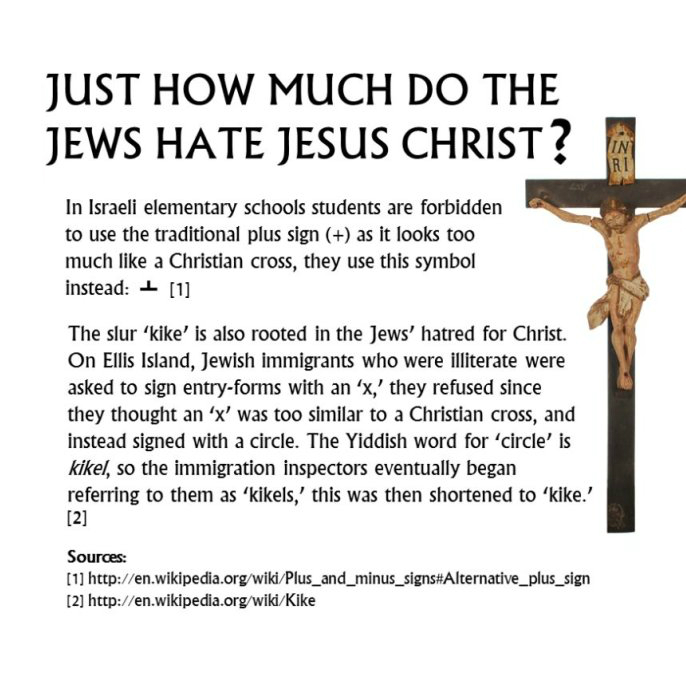
All non-Christians are generic heretics for not having come to Christ, and all non-Christians "crucified Christ" in the same sense I did; but that is not what people mean when they make Rabbinical Jews a special case. They mean that Judaism is itself as a system opposed to Jesus Christ, and the facts I've observed on the ground is that Judaism as a system tries very hard to take no position for or against Jesus Christ and to avoid taking such a position at great lengths. Even the separate allusion to Jews not wanting to mark with an "X" out of conscience is an avoidance of a position out of developed conscience and not an opposition. So, it's true the Rabbinical Jews are "heretics" in the same sense that all men are without Christ, but the fact that their Scriptures describe the true God in great detail indicates that we shouldn't preclude the idea that they might find the true God who is in Jesus by following the same Scriptures we use.
Yeah right. They never expressed anti-Christian sentiments - it was the evil Christians historically that prosecuted them for no reason at all. Or maybe the reason you don't find explicit evidence that they hate Christ and blaspheme Him is because they are wary of being caught in the act? They are careful about doing it in public but many jews who converted admit blaspheming Christ is a usual occurrence in their gatherings (they admit much more too). They're known to spit at the sound of our Lord's name. The reason they don't want to draw a cross or an X is because the sign of the cross repulses them and they know it has power. Satan and the demons squeal before the cross. Antichristian attitudes among the jews are well documented by the Church and by laypeople throughout history. The entertainment industry which is ran by jews mostly is full of antichristian sentiments and propaganda. Have you seen the Paris Olympics ceremony? Let's be real here.
So we don't get to diss the modern Jews when we remember how many OT Jews are saints in heaven watching us right now; instead we wait to point out our criticisms until we have established entree to speak where we will be heard and understood. That is done by demonstrating our ability to respect all Jewish history and treat the Jewish nation considerately: in fact, tongue in cheek, to treat them as considerately as any other goy (nation, Gen. 25:23).
You sound like an ADL lawyer dude. Come on. Don't conflate the Abrahamic hebrew tradition (which is Christianity) with the sect of Judaism. No Christian has a duty to respect judaizers who misinterpret Scripture and twist the truth. The Church Fathers didn't mince words too and would be considered "anti-semitic" by today's standards. Jews are not like the pagan nations because they know the one true God and His Son incarnated as a jew. They apostatized and rejected their own Messiah (I'm talking about the ones that did aka rabbinical Judaism) - this is what makes them distinct and why their judgment is different.
Now, I see the side issue is also interesting to you. I don't see the Torah laws "transformed" from legalism to liberty.
You're putting words in my mouth. I never said anything about liberty. The transformation that occurs is the result of the fulfillment of the OT rituals and symbols in the real body of Christ. All the symbols - circumcision, baptism, Temple worship, sacrifice, mana, Israel of God, etc were actualized in the God-Man. Worship is obedience and God requires to be worshipped as He has instructed us. Temple worship was appropriate until the Church was established.
Therefore he didn't "transform" it (but many people were so steeped in idolatry that restoration of their original did look like transformation). To the faithful Jews, of which up to a million accepted his message within the generation, he made it safe to keep the original Torah again.
If He didn't transform Mosaic law, then why don't we observe it as the jews do but worship in a different manner? It was impossible to observe the original Torah after the Temple was destroyed. The faithful became the Church and worshipped according to the NT, not the Torah.
As a Christian who teaches the Hebrew roots I know Messianics who argue it is proper for Christians to slaughter and eat a lamb for Passover at home (not at the church altar because that is not the law), and, while it would be an affront for someone not in the body of Christ to do so, I can't tell them they're sinning when they in good conscience eat lamb for Passover in exactly the same way Jesus himself did.)
I'm from Eastern Europe and slaughtering and eating lamb is an well known Pascha tradition. I don't see what the problem would be - it's a feast and we celebrate that way. It's not a sacrificial lamb of course and it has nothing to do with worship.
This leads to the objection: Something changed at the cross, so certain things "good" before are "bad" after. I don't see that being the change. The things that were bad after the cross were bad for not being from the heart, in the same way they were bad before the cross. The change was that the body of Christ was wide-open to Gentiles, and at the first Orthodox Council (Acts 15) it was recognized that Gentiles had the laws of Noah and not of Moses. Both legal systems point to the same God via the same requirement of trusting in the Anointed as God reveals him; they just apply to different nations. The Messianic Jews continued, as I showed, to keep the Torah as perfectly as it could be kept, and the Gentiles continued to honor the generic statement of the Ten Words (given to all nations) that the Council stated, which is one formulation of the Laws of Noah. So when the church's demographic became largely Gentile the operative demonstration of righteousness among them was (as always) the Laws of Noah, or effectively the Ten Words; but in our day the question of operative demonstration of righteousness, via changed heart, is being shifted back to recognizing that Jews are free to keep the Laws of Moses unto Jesus, just as Moses that great saint did.
It's not good vs bad - all of God's law is good and just. It is about what is appropriate for the time and the place. What was appropriate for Adam wasn't appropriate for Noah. What was appropriate for Noah wasn't appropriate for Moses, etc. Once God became flesh and was resurrected, the world was made anew so everything changed. Christ was the second Adam and He restored the pre-fallen human nature, defeating death and opening our path to eternal life in God. The jews of Acts 15 were part of the Church and they were allowed to continue OT worship but that was provisional and circumstantial and only applied to the very early days of the Church. Paul says there are no jews or gentiles but everyone is one in Christ. We all share the same faith, rituals and sacraments.
Like circumcision, the physical does not necessarily deny the spiritual, while if there is no circumcision of the heart then both are denied.
Never said that. I said the physical was fulfilled and transcended in Christ and the spiritual was left.


Judaism is premised on Christ not being the messiah, you know that right? Rabbinical judaism is the tradition of the Pharisees and the Sadducees developed after the destruction of the Temple in 70 AD and codified in the Oral Torah (the Mishnah and later the Babylonian Talmud). Do you know why they pray at the Western Wall? For the rebuilding of the Temple and the coming of the Messiah who will rule over Israel and the world.
There are two small problem with this plan if you're a Christian:
First, as we mentioned the Messiah already came and they rejected Him and crucified Him. I think every Christian not completely brainwashed by zionist dispensationalist propaganda is aware of that.
Second, the Kingdom of Israel, the Heavenly Jerusalem, is in fact the Church of Christ and not a political entity or an ethnostate. You see that dual covenant theory contradicts the teaching of the Church. Why? Because God's covenant with the jews was fulfilled with the coming of the Messiah.
The whole point of the OT and "the chosen people" was to bring about the Messiah. After that we the Church became the chosen people of God. This is why Christ is called not only the second Adam, but the second Jacob, because His 12 apostles gave rise to the new spiritual "tribes" around the world - not based on biological or ethnic inheritance, but as spiritual adopted children of God. This is why in Romans Paul says our circumcision is of the heart by the Spirit and not of the flesh. And still Protestants circumcise their children according to the jewish law disregarding Romans, as if God hasn't adopted us as His spiritual children. Paul made another allegory in Romans about this - jews are the olive branch that has been cut off and the Church of believers is the wild branch that was grafted and inherits eternal life in the Kingdom, previously promised to the jews.
Does God have a plan for the jews? Some Church Fathers speak of jews converting before the second advent. But there's no "separate dispensation" for the jews - they will either repent and come to the Church or they will be condemned to hell (the same choice stands before any jew or gentile at all times).
Yet.
To evangelize Rabbinical Jews (which is as sensitive as evangelizing Muslims), it's important to thank the historical people for preserving the covenant for thousands of years, among which Jesus and all the Church founders were born. The fact that one group said Jesus has done enough to be judged Messiah now, and the other (eventually) said Jesus hasn't done enough to be judged Messiah now, leads to the bridge-building method of dialoguing with Jews about how we would recognize Messiah before he finishes his work. I don't see a Christian eschatology in which we fail to pray for the coming of the Messiah who will rule over Israel and the world, and if he wants a physical temple as Ezekiel 40-48 hints then I'm sure he'll get one. So the issue is the let the Jews, who seek to keep their theology pure of outside influence, find Jesus in that historical theological testimony, because he's there everywhere. Without stumbling blocks, and also without compromise.
Actually, in Acts 3-4 the very Jews who called for Jesus's death became hundreds out of the first 5,000 members of your Orthodox Church. I've posted the exegetical proof but I trust you see it on plain reading (I don't think Tradition would interpret it differently than plainly).
Yes, dual covenant is contradictory and I've never taught it; Jews are only saved by accepting Jesus, just as the Old Testament Jews were saved by believing in a Messiah to come before his name had been revealed. There are no two covenants of salvation. However, many nations have various national covenants for good or ill in the Bible, and the Jewish people have some of the best and the worst of the covenantal promises, and their preservation is pretty good evidence that they have a national promise from God to remain a people forever just like Egypt has the same national promise from God to remain forever. In fact, Egypt is told by Zechariah that if they reject the Messiah they will get drought, which is similar to what Israel is told. National covenants are not related to salvation by faith proven by works.
So the "chosen people" (not a Biblical phrase), the people of God, were a mixed multitude for two millennia, then mostly Jewish for two, then mostly Gentile for two, which Paul tells us in Romans 9-11 is a brilliant and balanced plan for the world. He concludes with how much greater it will be to see Jews evangelized en masse again (like they were in his day, when Acts
2021:20 says many myriads in Jerusalem alone were Messianic Jews): he says in fact it means the time of eschatological resurrection is here when that happens.Side point, circumcision doesn't disregard Romans unless it is used as a work for independent merit. The good works we do, whether they look like Jewish law (e.g. baptism) or not, can only be done in gratitude for what we have received by grace and Christ's merit. There's a lot tied to that but it's tangential to your point.
Overall, you've got it pretty well right, and the issue is only that there are additional facts that open up the context of what is happening. I'm confident Orthodox would agree with evangelism to the Jews of the message of Jesus being God, Christ, and Savior, but those who have been working through this issue closely for the last ~150 years have recognized that much of the work is pre-evangelism, removing the rocks (and stumbling blocks) and watering and plowing up the hard ground. That also includes getting the church "more adequate explanation" as to how we can facilitate what Paul says will happen.
I never said all jews crucified and rejected Him. Obviously the great majority of the first Christians were jewish and many of those probably went against Christ at first (like Paul did). By "them" I'm referring to the pharisees and the sadducees who later consolidated the hebrew sect that we now call Judaism. As far as the Church goes, those people are heretics and don't worship the same God as Christians do.
Yes, it seems that jews will be there until the end. But most of today's jews are what Scripture calls false jews. The ashkenazi are not even semitic and have nothing to do with the jews of the Bible. This delves into a very complex question of what makes one a jew and how is this proven. In the OT we see that jews had to present written geneology. Even by the time of Jesus jews have already lost their records and the genealogies of Matthew and Luke serve as proof that He was the Messiah.
The problem is not that circumcision is jewish in origin - all Christian sacraments are because the tradition itself is jewish. The problem is that physical circumcision, just like baptism, was transformed in the NT. Same goes for laws pertaining to cleanliness and dietary laws. Continuing the jewish tradition is ignoring the fulfilling and transformation of the law and traditions brought by Christ. It's not putting things in their right place and order. An extreme case of this is observing the Sabbath as the holyday when Christ was resurrected in the first day of the week. After the Church was established at Pentecost, circumcising your children is denying the circumcision of the Spirit basically. This could even be red as blaspheming the Spirit... Imagine sacrificing a lamb at the Church altar in accordance with OT law? Would that be appropriate after Christ gave us the ultimate sacrifice? This is what circumcision is in essence.
u/guywholikesDjtof2024 you may want to read
(You have a lot of development there so I've written a lot, I trust your patience and discernment as you review it.)
Great! But you think that Jew, a proper noun, should be lowercase, even though lowercasing is registered in dictionaries as offensive? And would lowercase Judaism not be just grammatically improper? (It's literally a proper noun.) And would you use other racial terms judged offensive? Obviously it's common on this forum, but I bring it up since I'm talking about stumbling blocks.
But, more to the point, let's practice parsing to illustrate how I receive your words.
The first "they" could have antecedent as "Rabbinical [J]udaism". The second "they" cannot, so it must be either "the Pharisees and the Sadducees" or a generic reference, but you imply it's not a generic. And it's wasn't "the Pharisees" or "the Sadducees" as a collective who did it, but some of them, seeing as many Pharisees became Christians or were sympathetic (Hillel, Gamaliel, Nicodemus, Joseph, Paul, Acts 21:20). When the Bible uses a collective like this it's clear in context that it means some, but in English a collective like "the Pharisees crucified Messiah" is easily mistaken as being a delegated group activity attributable to all members rather than an activity of individuals. So, since you affirm you don't want to say it was all Jews, I suggest continuing sensitivity to whether your words might be mistaken that way.
See, there you refer both to people in 33 and literally to the same people consolidating much later, even if we propose that the Yavneh meetings started in 70. There are very few people who were active in both events, but by collective language you're speaking not only of both connected groups but also of all the connections of Rabbinical Judaism. That's a technical solecism, I'm confident you don't mean it, which is why I say there are more adequacies and contexts out there to glean.
And that would literally mean a very few people, but has the risk of painting a very broad brush. About the only historical person who I know might have contributed to both events is Yohanan ben Zakkai and since I don't know that he did I can't count him as a heretic. Now, we might point to anathemata that relate to Judaizing (none relate to Judaism as we now use the terms), but those are generic and not directed at any people-group but at individual behavior. So you leave the door open to the idea that all Rabbinical Jews today are special heretics for collectively crucifying Jesus and consolidating Judaism. But this is not a valid anathema (and we've discussed individual authority to make ecclesiastic proclamations). All non-Christians are generic heretics for not having come to Christ, and all non-Christians "crucified Christ" in the same sense I did; but that is not what people mean when they make Rabbinical Jews a special case. They mean that Judaism is itself as a system opposed to Jesus Christ, and the facts I've observed on the ground is that Judaism as a system tries very hard to take no position for or against Jesus Christ and to avoid taking such a position at great lengths. Even the separate allusion to Jews not wanting to mark with an "X" out of conscience is an avoidance of a position out of developed conscience and not an opposition. So, it's true the Rabbinical Jews are "heretics" in the same sense that all men are without Christ, but the fact that their Scriptures describe the true God in great detail indicates that we shouldn't preclude the idea that they might find the true God who is in Jesus by following the same Scriptures we use.
"False Jews" is not the text. Perhaps you've fallen into a trap laid for some by intending to mean Jesus's words "which say they are Jews, and are not, but do lie". Since Jesus says they're not Jews, they're not Jews. That leads to people objecting that many Rabbinical Jews are not Jews at all. In their own self-authoritative opinion. But Jesus always upheld the right of the Jewish nation to decide who was a Jew, and in general people-groups have the right to self-identify and to determine who is and who isn't a member (to say otherwise would be to say Americans can't enforce their border). So we don't get the right to "other" the Ashkenazi Jews, for instance, and say they're not Jews. Today's Ashkenazi have both Semitic and external (probably Khazarian) lineage, and the Jewish polity at large accepts this, and we don't get to say they made an error 1,000 years ago because that would be one nation (us) warring against another.
They are rightly in charge of their own genealogical records, and throughout the Old Testament we are shown how they operated this right, and when they took in foreigners (notably Rahab and Ruth, Jesus's grandmas) as being full Jews by naturalization. King David himself was accepted nationwide despite being known as 1/8 Moabite; he was chosen not because of blood but because of Ruth's citizenship vow (after being dissuaded three times) being held as normative in all court proceedings. So all the quibbling about a discovery a thousand years old is exceedingly disrespectful, as much as when today's "full-blood" Americans are being accused of being abusive slaveowners.
So I say all that from the standpoint that the Church must evangelize Jews and that Scored has a few common stumbling blocks that are easy to contribute to, but that the Church should logically reject. And I've said these things 5 years and not had any valid refutal. I say nothing against the Gentiles being grafted in, but I do say we are upheld by the root (Jesus) and the covenant people were largely Jewish/Israelite for almost the entire OT. So we don't get to diss the modern Jews when we remember how many OT Jews are saints in heaven watching us right now; instead we wait to point out our criticisms until we have established entree to speak where we will be heard and understood. That is done by demonstrating our ability to respect all Jewish history and treat the Jewish nation considerately: in fact, tongue in cheek, to treat them as considerately as any other goy (nation, Gen. 25:23).
Now, I see the side issue is also interesting to you. I don't see the Torah laws "transformed" from legalism to liberty. The fact is that the covenant people (excluding the idolatrous mixed multitude with them) could only ever have approached God via Christian liberty and not via legalism. That is why it's said Abel offered the first recorded sacrifice by faith. I was shocked when I realized my church had, by lapse, led me to believe that all the OT animal sacrifices were under a legalist system as if people earned something thereby. No, the ones who wanted to earn (like Cain) were excluded, God's soul hated their sacrifices; sacrifices could only, like any other work, be offered in gratitude for what God had already done and in faith for what he would do next. Jesus was circumcised, and had pigeons sacrificed for him (Luke 2), to fulfill righteousness, namely to demonstrate that according to the highest standard of the highest law he was scrupulous. And that law includes the right heart and cannot be kept without it (Deut. 30).
So when Jesus teaches on the law he never contradicts Moses (though he contradicts extraneous elder tradition like "hate your enemy"). He strengthens Moses by revealing the hidden heart matters that Moses fully meant but alluded to only indirectly as matters of conscience rather than formal law of human relations. Like every other prophet Jesus restores people to the fullness of righteousness from the heart. Therefore he didn't "transform" it (but many people were so steeped in idolatry that restoration of their original did look like transformation). To the faithful Jews, of which up to a million accepted his message within the generation, he made it safe to keep the original Torah again.
And another thing I was shocked by was that this continued after his resurrection. There are a few Scriptural proofs of this, but let me refer you again to Acts 21, where Paul pays for sacrifices that were offered in the then-standing temple. That's enough to illustrate the general trend: sacrifices could only be offered rightly from a heart that accepted what God had revealed (including the new revelation unique to that generation). The literal myriads (Greek) of Torah-observant worshippers in Jerusalem were offering a lot of sacrifices in that day: Luke's language could not mean less than 30,000 temple-honoring Messianic Jews. Therefore those Messianics, including over a million of the first members of your Orthodox Church who testify from heaven along with the OT saints, were continuing what Hebrews calls sacrifice by faith. Rabbinical Jews slaughtering chickens do not appear to be sacrificing by faith because even if they had the authority to substitute the chickens for themselves they don't demonstrate they have the heart. But Abel and Jesus and Paul did sacrifice animals by faith. (Now, without a temple, there are no authorized sacrifices today, except one, the Passover, which in the Torah was house to house. As a Christian who teaches the Hebrew roots I know Messianics who argue it is proper for Christians to slaughter and eat a lamb for Passover at home (not at the church altar because that is not the law), and, while it would be an affront for someone not in the body of Christ to do so, I can't tell them they're sinning when they in good conscience eat lamb for Passover in exactly the same way Jesus himself did.) Further, Ezekiel 40-48 indicates many future temple sacrifices when Jesus returns, and, although there are several eschatologies and I don't argue them, it's clear that on Jesus's return if he wants animal sacrifices he'll get them. (They may look more like time-honored American cookouts than we expect.)
This leads to the objection: Something changed at the cross, so certain things "good" before are "bad" after. I don't see that being the change. The things that were bad after the cross were bad for not being from the heart, in the same way they were bad before the cross. The change was that the body of Christ was wide-open to Gentiles, and at the first Orthodox Council (Acts 15) it was recognized that Gentiles had the laws of Noah and not of Moses. Both legal systems point to the same God via the same requirement of trusting in the Anointed as God reveals him; they just apply to different nations. The Messianic Jews continued, as I showed, to keep the Torah as perfectly as it could be kept, and the Gentiles continued to honor the generic statement of the Ten Words (given to all nations) that the Council stated, which is one formulation of the Laws of Noah. So when the church's demographic became largely Gentile the operative demonstration of righteousness among them was (as always) the Laws of Noah, or effectively the Ten Words; but in our day the question of operative demonstration of righteousness, via changed heart, is being shifted back to recognizing that Jews are free to keep the Laws of Moses unto Jesus, just as Moses that great saint did.
As I said in the summary, the "bad" was always works righteousness and legalism, it was never bad to strive to keep the law of Moses in liberty and gratitude as Jesus himself did. All NT objections to continuing to keep Jewish traditions were directed at doing so out of legalism ("under the law"). That's why Paul's legal defense in court was that he had not violated the Laws of Moses one whit: because he did so not under the law (but yet under Christ's law of liberty). He did so with full revelation of the fulfillment of the Law and its nonabolition, and its restoration in Christ. Sabbath is another can of worms that took me much longer to resolve: the fact is that the Lord's Day does have significance in pointing to the spiritual rest we have in Christ, but that does not change the significance Sabbath had in the Laws of Moses as kept and taught by Jesus (who spoke of Jews keeping Sabbath many years in the future, Matt. 24). Like circumcision, the physical does not necessarily deny the spiritual, while if there is no circumcision of the heart then both are denied.
TLDR: That's a lot but I'm happy to share what I've gleaned. I'm hopeful that as I've learned from other Orthodox you too will be open to dialogue. Accepting the many millions of Jewish saints in covenant history means right evangelism of the people today, recognizing that nobody was ever saved except by faith in God's Messiah, the promised seed of the woman. It also opens the door to understanding what true legalism really was and what true Christian liberty (including liberty to keep the law) really is. If you find repulsion in these thoughts, please consider that they are my best present understanding after years of studying the covenant, and I am always open to more (I don't know that I'm called to vow to Orthodoxy because I believe I'm called to evangelize Jew and Gentile with the gospel I've received). But I trust in the Spirit that you will see that there are some lines that you may not have been taught, as I was not taught them in my church but had to get them from the Word and the Spirit and in fact the primitive Church; and that we might be able to build bridges strengthening the relation of covenantalism to Orthodoxy (as I hinted with my enfolding of Orthodox theology as it reflects on Calvinism).
Granted it's not grammatically correct, but the rest is tone policing. It's not meant to be offensive. I'm not a native speaker and my language doesn't capitalize nouns. That's how I've always written jews, arabs, indians and other ethnic groups. I'm writing informally here and I consider this pedantry.
I said "they" refers to the pharisees and their tradition which brought about what we now call Judaism. Again you're being pedantic and I have to qualify everything I say - yes, not all pharisees went after Jesus. I'm obviously talking about those who did and formed their sect in opposition to Christ. Again, I'm not writing an academic paper here and even if my exposition is not without fault, I believe it manages to get what I mean across when understood within context.
Yes, I meant that passage. It still means the same so whatever. You're arguing over semantics.
Is this why Israel requires proof of jewish ancestry and DNA testing to get a citizenship? Go try to self-identify and see how it goes. The whole point of being jewish is "othering" non-jews aka gentiles. This is a constant theme in the OT.
Sure, they decide the legal notion because it's their state. But it doesn't change the fact that many of them are probably not descendent from the tribes of Jacob and are not jews/Isrealites in the sense used in the Bible.
Yeah right. They never expressed anti-Christian sentiments - it was the evil Christians historically that prosecuted them for no reason at all. Or maybe the reason you don't find explicit evidence that they hate Christ and blaspheme Him is because they are wary of being caught in the act? They are careful about doing it in public but many jews who converted admit blaspheming Christ is a usual occurrence in their gatherings (they admit much more too). They're known to spit at the sound of our Lord's name. The reason they don't want to draw a cross or an X is because the sign of the cross repulses them and they know it has power. Satan and the demons squeal before the cross. Antichristian attitudes among the jews are well documented by the Church and by laypeople throughout history. The entertainment industry which is ran by jews mostly is full of antichristian sentiments and propaganda. Have you seen the Paris Olympics ceremony? Let's be real here.
You sound like an ADL lawyer dude. Come on. Don't conflate the Abrahamic hebrew tradition (which is Christianity) with the sect of Judaism. No Christian has a duty to respect judaizers who misinterpret Scripture and twist the truth. The Church Fathers didn't mince words too and would be considered "anti-semitic" by today's standards. Jews are not like the pagan nations because they know the one true God and His Son incarnated as a jew. They apostatized and rejected their own Messiah (I'm talking about the ones that did aka rabbinical Judaism) - this is what makes them distinct and why their judgment is different.
You're putting words in my mouth. I never said anything about liberty. The transformation that occurs is the result of the fulfillment of the OT rituals and symbols in the real body of Christ. All the symbols - circumcision, baptism, Temple worship, sacrifice, mana, Israel of God, etc were actualized in the God-Man. Worship is obedience and God requires to be worshipped as He has instructed us. Temple worship was appropriate until the Church was established.
If He didn't transform Mosaic law, then why don't we observe it as the jews do but worship in a different manner? It was impossible to observe the original Torah after the Temple was destroyed. The faithful became the Church and worshipped according to the NT, not the Torah.
I'm from Eastern Europe and slaughtering and eating lamb is an well known Pascha tradition. I don't see what the problem would be - it's a feast and we celebrate that way. It's not a sacrificial lamb of course and it has nothing to do with worship.
It's not good vs bad - all of God's law is good and just. It is about what is appropriate for the time and the place. What was appropriate for Adam wasn't appropriate for Noah. What was appropriate for Noah wasn't appropriate for Moses, etc. Once God became flesh and was resurrected, the world was made anew so everything changed. Christ was the second Adam and He restored the pre-fallen human nature, defeating death and opening our path to eternal life in God. The jews of Acts 15 were part of the Church and they were allowed to continue OT worship but that was provisional and circumstantial and only applied to the very early days of the Church. Paul says there are no jews or gentiles but everyone is one in Christ. We all share the same faith, rituals and sacraments.
Never said that. I said the physical was fulfilled and transcended in Christ and the spiritual was left.